Paid search advertising drives targeted traffic fast. However, traffic alone does not pay the bills. Conversions do.
That’s where Landing Page Optimization becomes your most powerful advantage in 2026.
You can run brilliant ads. You can target the right keywords. But if your landing page fails to deliver, your ad budget quietly disappears. In this guide, we break down how Landing Page Optimization improves paid search conversions using real, proven practices aligned with Google’s guidelines and industry standards.
Every click costs money. If visitors land on a confusing or slow page, they leave.
Google clearly states that landing page experience influences both Quality Score and ad performance (Source: Google Ads Help Center – Landing Page Experience). A poor experience increases cost-per-click and reduces ad visibility.
In simple terms: bad landing pages make you pay more for worse results.
You wouldn’t invite guests into a messy store. So why send paid traffic to an unoptimized page?
The Connection Between Landing Pages and Conversion Rate
According to research from Google and industry insights from HubSpot, relevance, clarity, and usability directly affect conversions.
When landing pages match user intent, conversion rates improve. When they don’t, bounce rates increase.
Landing Page Optimization bridges that gap between click and action.
Users in 2026 expect:
Google’s Core Web Vitals remain a ranking and performance factor. Speed and usability no longer act as “nice to have” features. They define performance.
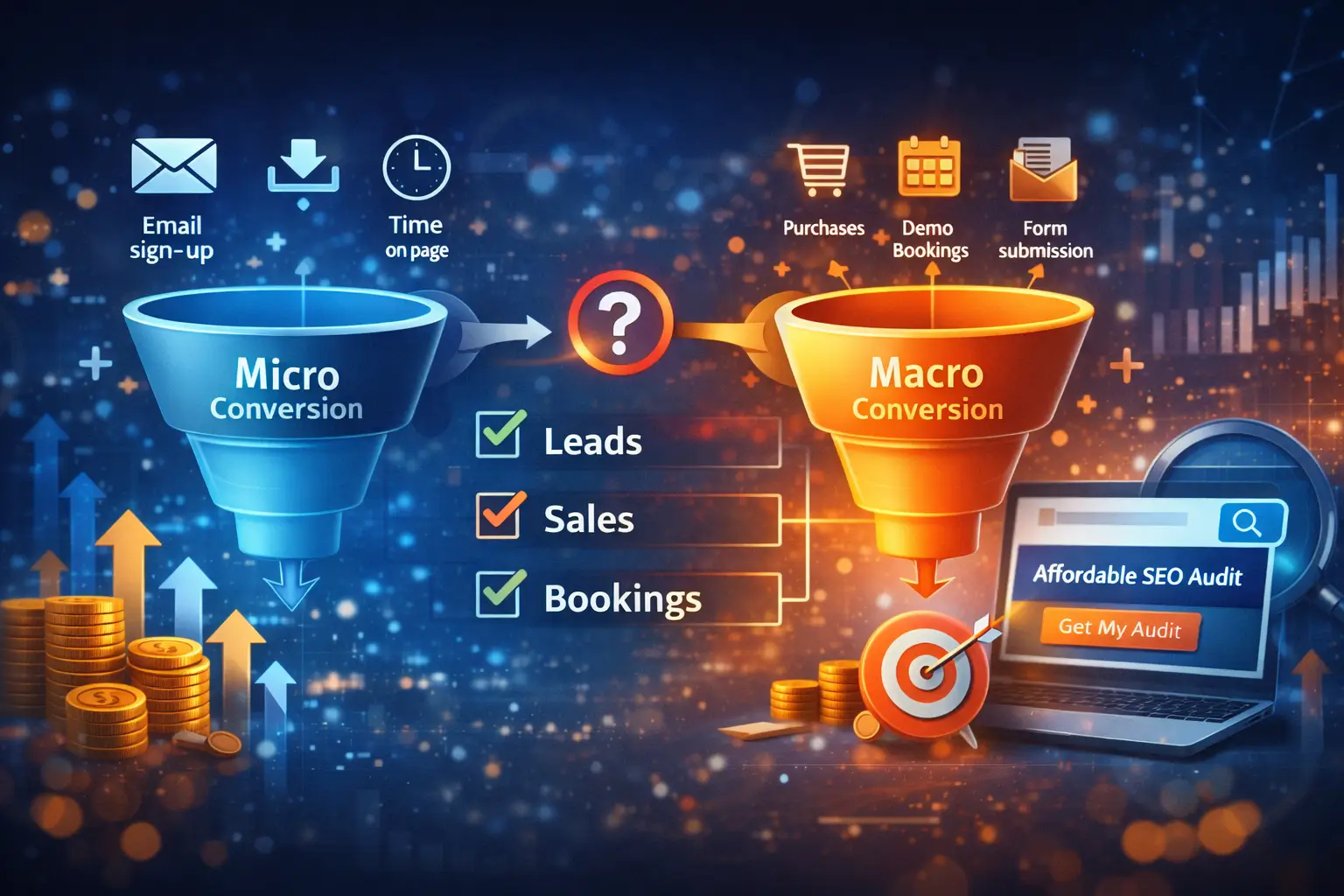
Not all conversions look the same.
Micro conversions signal engagement. Macro conversions generate revenue. Smart Landing Page Optimization tracks both.
Before you redesign anything, define your goal.
Do you want leads? Sales? Bookings?
Optimization without clarity feels like driving without a destination. You might move fast, but you won’t know where you’re going.
Use measurable KPIs such as conversion rate, cost per conversion, and bounce rate. Tools like Google Analytics help track these metrics accurately.
Search intent drives everything.
If someone clicks an ad for “affordable SEO audit,” your landing page must deliver exactly that. Not your company history. Not a general services page.
Message match increases trust instantly. Trust increases action.
Your headline confirms relevance in seconds.
When the headline mirrors your ad copy, visitors feel confident they clicked the right result. This practice reduces bounce rates and strengthens conversion intent.
Clarity beats cleverness every time.
Images and visuals guide attention.
Use product visuals, explainer graphics, or short videos to reinforce your value proposition. Avoid stock overload. Every visual must support your message.
Visual hierarchy keeps users focused on action.
Persuasive copy solves a problem.
Focus on benefits. Highlight outcomes. Address objections.
Short paragraphs improve readability. Clear language improves trust. Specific promises convert better than vague claims.
Avoid fluff. Every sentence should move the reader closer to action.
Your CTA must stand out.
Use action-oriented phrases like:
Place CTAs strategically above the fold and after key sections. Limit competing buttons. Confused users rarely convert.
Mobile traffic dominates paid search.
Google uses mobile-first indexing. If your landing page struggles on mobile, your conversions will too.
Ensure:
Test your pages using Google’s PageSpeed Insights tool.
Speed influences both user experience and ad performance.
Google confirms that landing page experience affects Quality Score. Faster pages improve user satisfaction and reduce abandonment.
Compress images. Minimize scripts. Use caching.
Even a one-second delay can reduce conversions significantly, according to industry research from Think with Google.
White space improves readability.
It guides users naturally from headline to CTA. Crowded pages overwhelm visitors. Clean design builds authority.
Good design feels invisible. It supports action without distraction.
Remove unnecessary navigation.
Eliminate unrelated links. Focus attention on one primary action.
Landing pages differ from websites. Websites inform. Landing pages convert.

Testing removes guesswork.
Test one variable at a time:
Small adjustments often produce measurable gains.
Use data to guide decisions.
Track:
Integrate Google Ads with Google Analytics for deeper insights. Data keeps optimization objective.
Optimization never ends.
Instead of redesigning everything, improve incrementally. Test. Measure. Refine.
Over time, small improvements compound into significant ROI gains.
Dynamic keyword insertion improves message match.
If a user searches for “B2B SEO services,” show that exact phrase in your headline.
Relevance increases engagement.
Dynamic sections adapt based on:
Personalization makes visitors feel understood. And people convert when they feel understood.
Retargeted users expect continuity.
Ensure your landing page reflects previous interactions. Align messaging with earlier touchpoints.
Consistency strengthens trust.
When ads promise one thing and pages deliver another, trust disappears.
Message mismatch remains one of the biggest conversion killers.
Too many options reduce decisions.
Focus on one primary action. Secondary actions should remain subtle.
Slow mobile pages destroy ROI.
Always test performance across devices. Speed and usability remain non-negotiable.
At Prodigmar, we build strategies on measurable insights.
We analyze traffic sources, keyword intent, heatmaps, and conversion data before making changes.
Data drives decisions.
We never treat Landing Page Optimization as a one-time task.
Prodigmar test continuously. We refine strategically. We measure consistently.
Paid ads and landing pages must work together.
Our team integrates Google Ads strategy with conversion-focused design to maximize ROI.
Learn more about our approach on our internal strategy page:
/paid-search-strategy-guide
For further reading on Google’s landing page experience guidelines, visit:
https://support.google.com/google-ads/answer/2404197
Markets evolve. User behavior shifts. Competitors adapt.
Consistent Landing Page Optimization keeps you competitive.
Success happens when:
Ads attract qualified users
Landing pages deliver relevance
Analytics guide improvement
Alignment produces measurable growth.
Paid search remains competitive in 2026.
Expert guidance accelerates results. Strategic optimization reduces waste. Data-driven improvements increase profitability.
Landing Page Optimization transforms traffic into revenue. When executed properly, it strengthens trust, boosts ROI, and supports long-term growth.
You don’t need more likes - you need results.
Let’s build a system that generates leads, not just impressions.
Book Your Free Strategy Call Now →Landing Page Optimization improves page elements to increase conversions from paid traffic.

Click to chat