Every click has potential. Not every click converts.
That gap is where integrated marketing lives – blending PPC, SEO, social media, and content marketing into one strategy instead of four separate ones. Done right, it multiplies ROI through consistency and smarter targeting.
Done wrong, it just makes your reporting more confusing while your budget quietly leaks. We’ll cover both sides here — including the parts most marketing blogs conveniently skip.
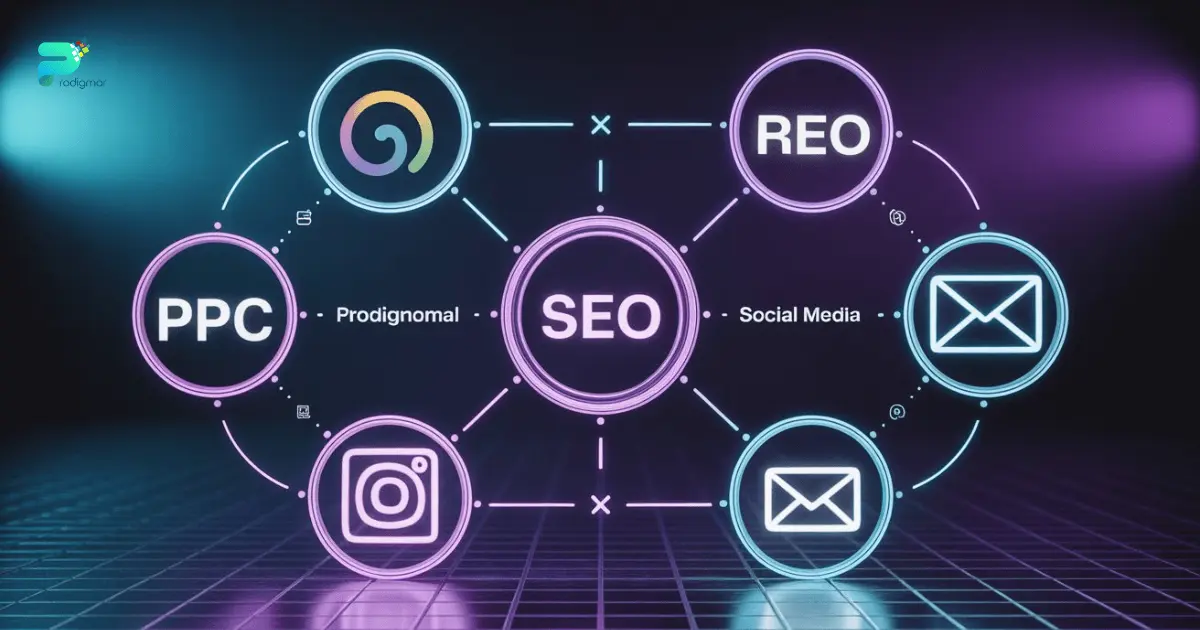
Digital marketing used to run in silos. Your PPC team optimised for clicks. Your SEO team optimised for rankings. Your social team optimised for likes. Nobody optimised for the same goal.
That model doesn’t hold up anymore. Integrated marketing connects every touchpoint – ad, email, blog post, social update – toward one shared conversion goal. It turns a scattered set of channels into a single customer journey.
The upside is real. The catch is that integration takes discipline, not just more channels. We’ll get to that.
Run PPC, SEO, and social separately for long enough, and the cracks show up fast. A prospect sees your ad, likes it, then lands on your blog a week later and doesn’t recognise your brand – because the tone, offer, or message shifted between touchpoints.
That inconsistency costs you conversions you already paid for.
Integration fixes this by aligning every channel under one message and one conversion goal. Simple in theory. Harder in execution, especially once budgets and teams grow — more on that later.
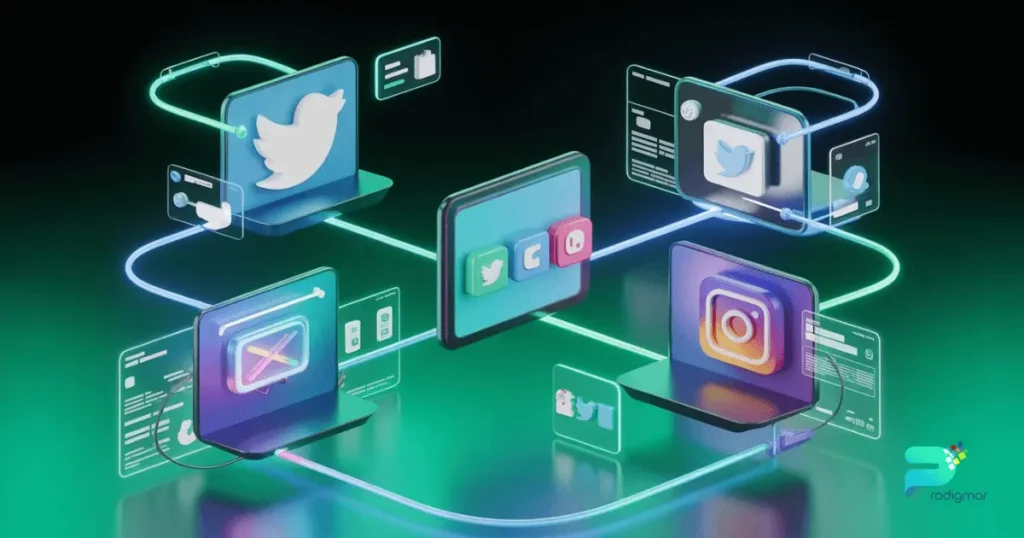
Think of integrated marketing as an ecosystem, not a checklist. Each channel feeds the next one instead of competing with it.
Together, they reinforce brand recall in a way no single channel can manage alone.
PPC is usually the fastest way to reach a buyer who’s already decided to look. It captures high-intent traffic instantly, without waiting months for rankings.
But PPC on its own has a short memory. Once the ad spend stops, so does the traffic. When PPC lands on a page backed by solid organic content and real social proof, conversion rates climb – because the visitor isn’t landing on an island. This is the version of PPC we run alongside SEO and content for every Prodigmar client, rather than treating it as a standalone line item.
Social media gives a brand a voice outside the sales pitch. Integration means the same offer a user saw in a PPC ad should feel familiar when it shows up on Instagram, Facebook, or LinkedIn a few days later.
That consistency is what nurtures trust until someone’s actually ready to buy — instead of forcing the decision on the first click.
PPC gets you speed. Content and SEO get you compounding returns.
A blog post published today can still be sending traffic – and building topical authority – two years from now. A user who clicks a PPC ad but doesn’t convert might return weeks later through an organic search, closing the loop the paid ad started. That’s the conversion your last-click report never gives PPC credit for, and it’s exactly the kind of gap we’ll unpack in the attribution section below.
Integration lives or dies on shared data. Without it, every channel is optimising for its own version of “success.”
Google Analytics 4 (GA4) now uses data-driven attribution as its default model, which uses machine learning to split conversion credit across touchpoints instead of handing 100% to whichever channel happened to close the deal. That’s a meaningfully fairer way to judge PPC, SEO, and social side by side — though, as you’ll see further down, “fairer” doesn’t mean “fully accurate.”
Mapping the customer journey means treating every touchpoint as a deliberate step, not a random encounter. An ad, an email, a blog post, a retargeting nudge — each one should feel like the logical next step, not a repeat of the last one.
Done well, this shortens the path to purchase. Done badly, it just means the customer sees the same message five times and starts ignoring all of them.
AI-driven personalisation connects your CRM, ad platforms, and on-site behaviour so the right offer reaches the right person. Automation handles the follow-through — reminders, retargeting sequences, cart-abandonment nudges — without a human manually triggering each one.
Used well, this raises ROI. Used lazily — blasting the same automated sequence to everyone regardless of behaviour — it just becomes spam with better timing.
Here’s the part most articles skip entirely: integration isn’t automatically additive. Sometimes it’s just double-counting the same customer twice.
The most common example: bidding on your own branded terms in PPC while also ranking #1 organically for the same term. You’re often paying for a click you would have gotten for free — and your dashboard reports it as “PPC-driven revenue” anyway.
This isn’t a hypothetical. It’s a standard test agencies run:
The honest rule of thumb: integration adds value when channels reach different people at different stages. It just adds noise when two channels are fighting over the same click and calling it teamwork.
A lot of “integrated marketing” advice online is written to sell the concept, not question it. Here’s the version we’d tell a client over coffee.
| The Myth | The Reality |
|---|---|
| More channels always mean more ROI | Adding channels without a shared offer or message often just raises your cost per acquisition |
| Multi-touch attribution shows "the truth" | Every attribution model is still a statistical estimate, not a courtroom-grade fact — Google itself frames data-driven attribution as machine-learning-based credit assignment, not perfect measurement |
| Automation equals personalisation | Automation without clean, accurate customer data just sends irrelevant messages faster |
| One consistent message works everywhere | Channel-native tone — LinkedIn ≠ Instagram ≠ email — usually outperforms copy-pasting the same line everywhere |
| You need every channel live from day one | Testing two channels, proving the connection, then expanding beats switching everything on at once |
None of this means integration doesn’t work. It means it works when it’s built deliberately, not adopted as a buzzword.
Prodigmar audits your current PPC, SEO, and social performance and tells you — honestly — what's working, what's overlapping, and what's just adding noise to your reports.
Book a Free Marketing Audit →This one matters more every year, and almost nobody outside agency circles talks about it plainly: your ROI numbers are probably less precise than they look.
When Apple introduced App Tracking Transparency with iOS 14.5 in 2021, it required apps to ask permission before tracking users across other apps and websites. Most users said no — independent tracking studies put opt-in rates in the roughly 15–25% range globally, which quietly broke a lot of the cross-platform data ad platforms had relied on for years.
The knock-on effects, documented across multiple industry analyses, included:
Here’s what that means practically: if a chunk of your “measured” ROI is coming from modelled data rather than observed clicks, your dashboard is giving you an educated guess dressed up as a number.
What actually holds up:
This is the mindset that separates agencies who present ROI with appropriate humility from ones who present a dashboard number as gospel.
Everything above assumes one brand, one market. Scaling integration across regions, franchises, or multiple product lines is where most growth-stage businesses actually struggle — and it’s rarely covered in beginner content.
A few things that break at scale:
The takeaway: integration strategy isn’t a fixed formula. It has to evolve as the business does, or it becomes the exact fragmentation it was meant to fix.
Every integrated-marketing article assumes integration is always the answer. It isn’t.
Skip or delay full integration if:
A simple gut-check before you integrate:
Knowing when not to integrate is just as valuable as knowing how — and it’s the difference between advice that fits your business and advice that fits a template.
Integrated marketing ROI isn’t a single-channel scoreboard anymore. The metrics worth tracking together include:
Viewed together, these reveal what a single-channel report never will: whether your channels are genuinely reinforcing each other, or just taking turns claiming the same win.
Most brands jump into integration without a plan, then wonder why it doesn’t “feel” more efficient. The recurring mistakes:
The fix: start with two or three channels, prove the connection between them, then expand once the data backs it up.
The businesses winning right now think holistically, not channel-by-channel. Integration reduces wasted spend, sharpens every touchpoint, and turns scattered clicks into a customer journey that actually goes somewhere.
It isn’t magic. It isn’t automatic. But built deliberately — with honest measurement and the right channel mix for your stage — it’s still the strongest lever most businesses have for turning traffic into revenue.
Prodigmar builds integrated PPC, SEO, and social campaigns designed around your actual growth stage — not a one-size-fits-all playbook.
Talk to Our Team →Clicks get attention. Conversions build businesses. Integrated marketing connects the dots between every digital touchpoint — but only when it’s built with honest measurement, the right channel mix, and realistic expectations about what attribution can and can’t tell you.
Whether it’s PPC, SEO, or social media marketing, Prodigmar helps brands turn fragmented traffic into ROI that holds up under scrutiny — not just in the dashboard.
Integrated marketing connects all digital channels — like PPC, SEO, social media, and eIntegrated marketing connects all digital channels — like PPC, SEO, social media, and email marketing — into one cohesive strategy. This unified approach ensures consistent messaging, improves customer experience, and increases conversion rates, directly boosting ROI.— into one cohesive strategy. This unified approach ensures consistent messaging, improves customer experience, and increases conversion rates, directly boosting ROI.
PPC delivers fast results through targeted ads, while SEO builds long-term organic growth. When both are aligned, PPC data helps refine SEO keywords, and SEO strengthens brand visibility, leading to more efficient ad spending and higher-quality conversions.
Social media acts as a bridge between awareness and conversion. By syncing it with PPC campaigns and content marketing, businesses can retarget users, share consistent brand messages, and maintain engagement throughout the customer journey.
Data analytics reveals how different channels contribute to conversions. Tools like Google Analytics 4 track user behavior across campaigns, helping marketers identify top-performing touchpoints and optimize spending to maximize ROI.
In 2025, customer behavior is multi-platform. Businesses that unify SEO, social media, and paid campaigns create seamless journeys that feel personalized. This not only enhances brand loyalty but also generates stronger, measurable ROI growth over time.
Click to chat
No spam. No commitment. Just real insights.
We’ll contact you on WhatsApp about your audit. No commitment required.
No spam. No commitment. Just real insights.
We’ll contact you on WhatsApp about your audit. No commitment required.