
Social media marketing is no longer optional for small businesses. It’s one of the most direct ways to reach your audience, build trust, and generate leads.
But let’s be honest – posting random content and hoping for results is not a strategy. It’s more like throwing darts in the dark and blaming the board.
If you want real growth, you need a structured approach backed by data, not guesswork.
Social media marketing involves using platforms like Facebook, Instagram, and TikTok to promote your business, connect with your audience, and drive measurable results.
According to reports published by industry leaders like HubSpot and Statista, businesses that use structured social media strategies see better engagement and higher conversion rates compared to those that don’t.
In simple terms:
👉 Social media helps people find you
👉 Strategy helps them trust you
👉 Ads help them buy from you
Small businesses don’t always have large budgets. That’s exactly why social media becomes powerful.
Here’s what it helps you achieve:
Unlike traditional marketing, you can track everything – clicks, leads, and conversions. No guesswork, just data.
Stop guessing and start growing with a proven approach.
No commitment. No credit card required. Limited slots available.
Get Your Free Social Media Strategy & Audit Today →Engagement rate gets treated like a scoreboard. It isn’t one.
A post can rack up likes and comments while doing nothing for your revenue. That’s not a hypothetical – it’s one of the most common blind spots small business owners walk into.
Here’s the pattern: a giveaway post or a controversial meme repost pulls in strong engagement. The account owner feels great about it. Three months later, the sales numbers haven’t moved, and nobody can explain why.
What’s actually happening:
Engagement driven by giveaways, memes, or controversy attracts people who want the giveaway, the meme, or the argument — not your product. Reach and revenue quietly decouple.
The fix isn’t to ignore engagement. It’s to check what kind of engagement you’re getting.
| Vanity Engagement | Revenue-Linked Engagement |
|---|---|
| High reach, low website clicks | Moderate reach, steady clicks |
| Comments are jokes/tags, not questions | Comments ask about price, availability, booking |
| Spikes around giveaways or trends | Spikes around product posts, offers |
| Followers grow, DMs don't | Followers grow, DMs and inquiries grow together |
| Engagement-to-follower ratio jumps suddenly with no traffic increase | Engagement tracks with site traffic and leads |
A simple gut-check before you report a “win”: did this post produce a click, a DM, a booking, or a sale – or just a reaction? If you can’t answer that, you’re not tracking the metric that matters.
Small businesses with tight, well-targeted audiences often see lower engagement percentages than accounts chasing broad reach — and still outperform them on actual leads. Engagement rate tells you attention. It doesn’t tell you intent.
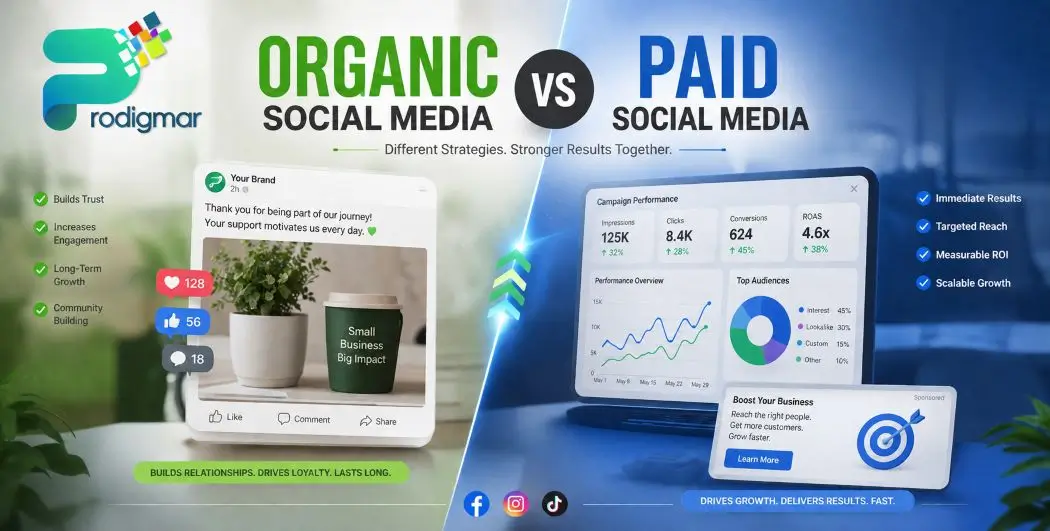
Let’s clear a common confusion.
This includes posts, reels, and stories. It builds trust and keeps your audience engaged.
But growth is slow.
This includes Facebook Ads and Instagram Ads. It helps you reach new audiences and generate leads quickly.
But it needs strategy.
👉 The smart approach is not choosing one.
👉 The real growth comes from combining both.
Every guide tells you social media works if you stay consistent. That’s true – for the right business. It’s not universally true, and pretending otherwise sets people up to waste months of effort.
Here’s where social media structurally underperforms, no matter how good the content is:
Low-consideration, high-urgency local services. A locksmith or emergency plumber has customers searching in the exact moment of need. That’s a Google Maps and search-intent problem, not a scrolling-feed problem. Consistency on Instagram won’t out-position a competitor who shows up in the “near me” search.
Long B2B sales cycles with small buyer pools. If your total addressable market is 200 companies and your sale takes six months of relationship-building, broad social content spreads effort thin. Direct outreach and LinkedIn relationship-building typically outperform feed content here.
Highly regulated industries. Financial services and healthcare businesses often lose weeks to compliance review on every single post. By the time content is approved, the trend or relevance window has closed. Posting cadence collapses, and so does organic growth.
Businesses with no visual product. A B2B compliance software company or a niche industrial supplier struggles to produce visually engaging content cheaply. Content cost per post climbs, and the return doesn’t justify it compared to other channels.
Quick self-check before investing in social media:
If two or more answers point away from social, it’s not a failure of effort – it’s a channel mismatch. Recognizing that early saves budget and burnout.
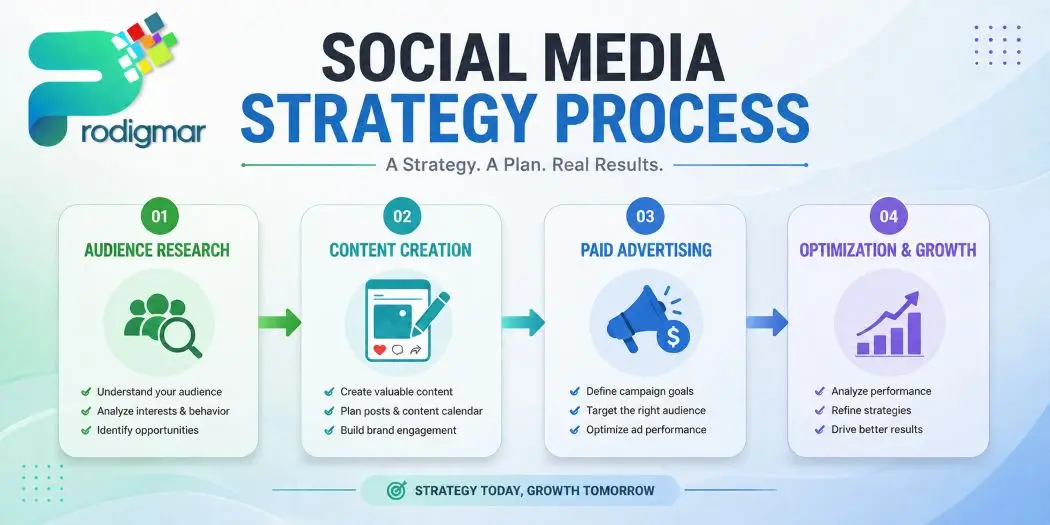
A strong strategy doesn’t need to be complicated. It needs to be consistent.
Know who you are targeting. Age, interests, and behavior matter more than guesses.
Your content should either:
If it does none of these, it gets ignored.
Most advice treats “the algorithm” like one universal rulebook. It isn’t. Each platform rewards and punishes different behavior, and those rules shift without warning.
Instagram currently favors original video over reposted content – especially clips still carrying another platform’s watermark. A TikTok video reposted straight to Reels with the watermark visible typically gets suppressed reach compared to a native upload.
Facebook still leans toward native video and Groups activity over standard Page posts for small business accounts. A post inside an active, relevant Group frequently outperforms the same content posted to the Page feed.
Posting frequency thresholds differ by platform. Some platforms suppress reach if you post too many times in a short window (feed fatigue signals). Others reward higher frequency, provided each post gets early engagement. There’s no single “ideal number of posts per week” that applies everywhere – it depends on the platform and the audience’s response pattern.
The first 30-60 minutes matter more than total engagement. Posting time isn’t just about “when your audience is online.” It’s about giving the post its best shot at early engagement velocity, which most platforms use as an initial distribution signal.
A caution: these mechanics shift regularly. A lot of “best practices” advice still being shared online is a year or two out of date. Treat any specific platform rule – including the ones above – as directional, not permanent, and revisit it periodically.
Even a small budget can generate results when targeting is correct.
Look at performance regularly:
Then adjust accordingly.
If you want faster results, focus on:
Consistency beats perfection every time.
Small business owners hear a lot of secondhand “rules” about social media. Some are outdated. Some were never true. Here’s where the common wisdom breaks down.
| Myth | Reality |
|---|---|
| More followers = more sales | Follower count and revenue often decouple. A smaller, well-targeted following converts better than a large, unfocused one. |
| Viral content grows your brand | Viral reach often pulls in the wrong audience - bargain hunters and meme-scrollers with low purchase intent and poor retention. |
| You need to post every single day | Overposting without a real content system produces filler that can suppress reach and dilute how your brand is perceived. |
| Paid ads guarantee leads | Ads amplify what's already working - or not. A weak offer or a slow landing page just gets more expensive to fail with. |
| Organic reach is dead, so don't bother | Organic content still builds trust and lowers cost-per-acquisition for paid campaigns retargeting people who've already seen it. |
None of these realities mean the underlying tactic is useless. They mean the tactic only works under specific conditions – and skipping that nuance is exactly how businesses end up disappointed by a strategy that was never wrong, just misapplied.
Even good businesses fail here.
Social media is not magic. It’s a system.

Businesses that succeed on social media don’t rely on luck.
They:
This is why structured marketing consistently outperforms random posting.
This section assumes you already understand the basics of running social campaigns. It’s for readers ready to prove – not guess – what social media is actually contributing to revenue.
Most small businesses can tell you their follower count. Very few can tell you how many closed deals started with a social media touchpoint. That gap is where budget gets wasted or under-invested.
Step 1: Standardize UTM parameters. Every campaign, every platform, every post type gets a consistent UTM structure (source, medium, campaign name). Without this, social traffic blends into “direct” or “unknown” in your analytics, and you lose the ability to separate what’s working.
Step 2: Connect ad pixels to actual CRM events, not just form submissions. A Meta Pixel or TikTok Pixel firing on “form submitted” tells you a lead came in. It doesn’t tell you if that lead closed. Connecting pixel data to your CRM’s deal-stage events (qualified, proposal sent, closed-won) lets you trace revenue back to the campaign that started it — not just the lead.
Step 3: Move past last-click attribution. Last-click credits whichever channel got the final click before conversion – usually a direct visit or a Google search, even if a social post is what started the buyer’s interest weeks earlier. A lightweight multi-touch view (even a simple spreadsheet tracking first-touch and last-touch per lead) gives a far more honest picture than last-click alone, without needing enterprise attribution software.
Step 4: Account for “dark social.” Someone sees your Instagram post, doesn’t click, but later searches your brand name directly or asks a friend. That lead shows up as “direct traffic” with zero social credit. You can’t eliminate this, but you can estimate it – a noticeable rise in branded search traffic following a content push is a reasonable proxy for dark social influence.
Step 5: Know when to formalize the system. A spreadsheet tracking UTMs and lead sources is enough for low lead volume. Once lead volume grows to the point where manual tracking becomes unreliable or time-consuming, that’s the signal to invest in a proper CRM-to-ad-platform integration rather than continuing to patch a manual process.
The realization this unlocks: once this workflow is in place, “does social media work for us” stops being a matter of opinion. You can point to the number.
Social media marketing works – but only when done right.
If you focus on strategy, consistency, and data, you can:
Otherwise, you’ll just stay busy… without results.

You don’t need more likes - you need results.
Let’s build a system that generates leads, not just impressions.
Book Your Free Strategy Call Now →Click to chat
No spam. No commitment. Just real insights.
We’ll contact you on WhatsApp about your audit. No commitment required.
No spam. No commitment. Just real insights.
We’ll contact you on WhatsApp about your audit. No commitment required.