Search doesn’t work the way it did two years ago. Half your customers might get their answer from an AI summary before they ever see your website. That sounds terrifying if you’ve built your business on organic clicks. It’s actually good news if you know where to focus.
This guide walks through the digital marketing trends 2026 that matter most: how AI reshaped search, why Performance Max quietly took over Google Ads, what happened to the cookie apocalypse everyone predicted, and where short-form video actually pays off. No fluff, no recycled 2023 predictions dressed up as “new.”
Let’s get into it.
The biggest digital marketing trends in 2026 are AI search optimization, stronger SEO trust signals, short-form video, smarter paid advertising, marketing automation, first-party data, and local search growth. Businesses that want more leads in 2026 need websites that are fast, helpful, easy to understand, and built around real customer questions.
AI tools like Google AI, ChatGPT, Gemini, and Perplexity are changing how people discover brands. Instead of only ranking for keywords, businesses now need clear service pages, expert content, reviews, case studies, schema, and strong brand signals so search engines and AI systems can understand who they are and why they are trustworthy.
For small businesses, the best strategy is not to follow every trend. The goal is to choose the channels that can generate real leads: SEO for long-term visibility, Google Ads for faster traffic, social media for trust and awareness, email marketing for follow-up, and conversion-focused web design to turn visitors into enquiries.
Three forces collided in 2025 and 2026: generative AI moved into search results, browsers kept chipping away at tracking cookies, and consumers shortened their attention spans even further. None of these forces is new on its own. Together, they forced a rewrite of the digital marketing playbook.
The businesses adapting fastest treat this as structural change, not a temporary disruption. The ones waiting for things to “go back to normal” are watching their organic traffic slide, quarter after quarter.
Here’s what’s actually driving 2026 strategy.
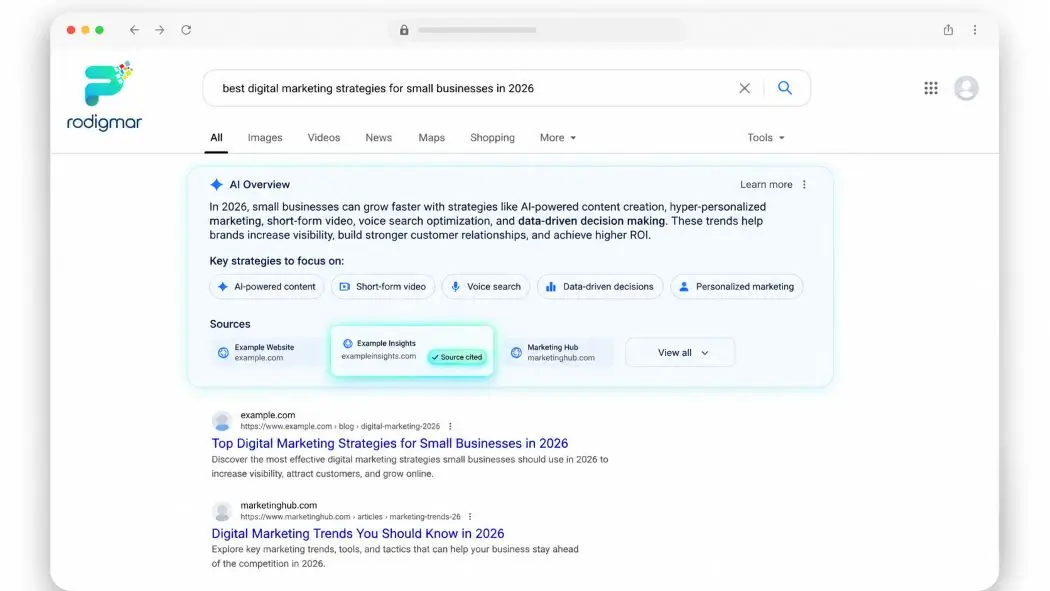
Google’s AI Overviews now appear on roughly 48% of all search queries, up sharply from around 31% a year earlier, according to BrightEdge data reported by SQ Magazine. That’s not a niche feature anymore. It’s nearly half of all Google searches.
The catch: multiple independent studies, including a controlled field experiment covered by Search Engine Journal, found that AI Overviews cut outbound clicks on the queries where they appear, with organic click-through rates dropping substantially. Pew Research separately found users click through roughly half as often when an AI Overview is present.
Here’s the twist that should change how you think about SEO. Brands that get cited inside an AI Overview don’t lose out, they gain. Seer Interactive’s research shows cited brands earn about 35% more organic clicks than uncited competitors on the same search results page. Getting mentioned by the AI beats ranking #3 the old-fashioned way.
While everyone panics about AI Overviews, local search is having a moment. Around 76% of voice searches carry local intent, “near me,” “open now,” “best X nearby,” according to BrightLocal data cited across multiple industry reports. Voice search itself accounts for somewhere between 20% and 27% of global queries depending on the study, and that share keeps climbing.
Local voice searches convert fast too. Businesses with complete, accurate Google Business Profiles get significantly more voice search visibility than those with gaps in their listings, per Synup’s research. If your hours, address, and reviews aren’t buttoned up, you’re handing customers to a competitor who bothered to fill out their profile properly.
Core Web Vitals haven’t gone anywhere. Pages that load fast and behave predictably on mobile continue to outrank slower competitors, and that hasn’t changed just because AI entered the picture. If anything, speed matters more now: voice search results, in particular, tend to favor pages that load noticeably faster than average.
| SEO Priority | 2025 Approach | 2026 Approach |
|---|---|---|
| Content Focus | Keyword density and exact-match phrasing | Topical depth and comprehensive answer coverage |
| Authority Signals | Backlinks as the primary trust signal | Backlinks plus AI citations and brand mentions |
| Content Format | Long, text-only pages | Structured, extractable content (clear headers, direct answers, schema markup) |
| Success Metric | Organic traffic and rankings | Traffic, rankings, and share of voice inside AI-generated answers |
| Page Structure | Optimized primarily for human scanning | Optimized for both human readers and AI extraction |
| Local Visibility | Keyword-based local pages | Conversational, voice-ready local content tied to Google Business Profile |
If your traffic has been sliding and you're not sure whether AI Overviews, a Core Web Vitals issue, or outdated content is to blame, our team can run a full visibility audit and show you exactly where you're losing ground - and how to fix it.
Get a Free SEO Audit from Prodigmar →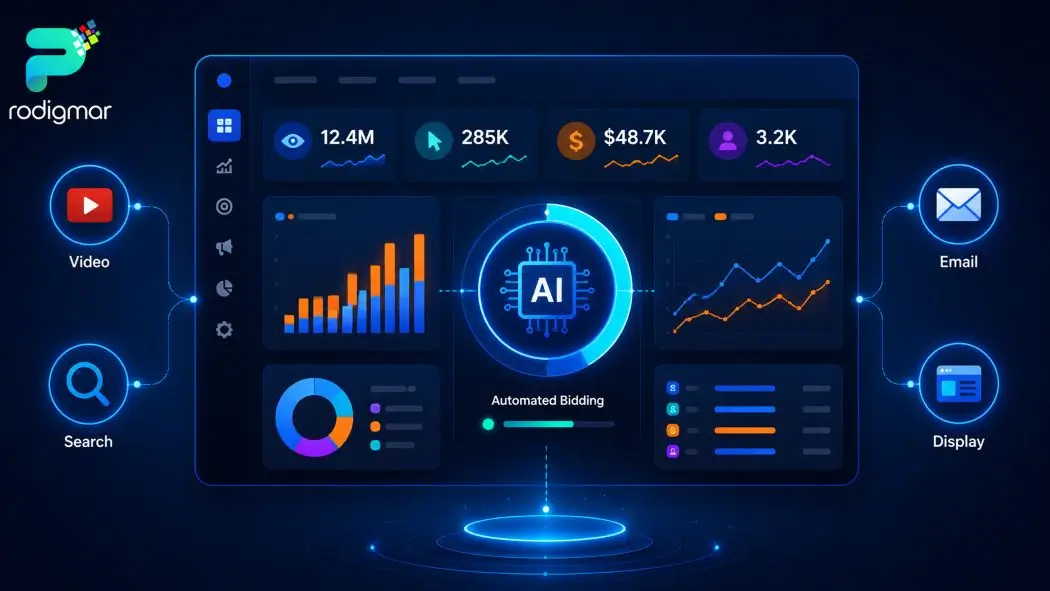
Paid search changed just as much as organic. Performance Max, Google’s AI-driven campaign type that runs ads across Search, Display, YouTube, Gmail, and Maps from one campaign, went from a niche option to the default. More than 70% of Google Ads advertisers now run at least one Performance Max campaign, according to survey data reported by Fluency, up sharply from 2024 adoption levels.
Does it work? Mostly, yes. Early adopters report meaningfully higher conversion rates compared to standard Search campaigns, and Google’s own data points to Performance Max delivering better ROAS in aggregate. That said, results vary a lot by industry and by how well the account is set up. PMax rewards businesses with strong creative assets and clear audience signals; it punishes lazy setups just as efficiently as it rewards good ones.
Remember the great cookie apocalypse everyone predicted? It didn’t quite happen the way headlines suggested. Google reversed its plan to fully deprecate third-party cookies in Chrome, opting instead for a “user choice” model where users decide their own tracking preferences. But don’t mistake that for a reprieve.
Safari and Firefox have blocked third-party cookies by default for years already, and a large share of Chrome users are expected to opt out once given a clear choice. Combined with widespread ad-blocker use, a significant chunk of web traffic is already invisible to old-school tracking methods, regardless of what Chrome officially does.
The practical takeaway: first-party data (your email list, your CRM, your logged-in users) is now your most reliable targeting asset. Businesses that built an email list or a loyalty program are sitting comfortably. Businesses that relied entirely on third-party cookies are scrambling.
Honestly? Both, but for different jobs.
| Factor | SEO | PPC |
|---|---|---|
| Time to Results | 3–6+ months | Immediate |
| Cost Structure | Upfront investment, compounds over time | Ongoing, scales with spend |
| Control | Less direct control over rankings | Full control over budget and targeting |
| Best For | Long-term brand equity, informational content | Product launches, time-sensitive offers |
If you need leads next week, PPC wins. If you’re building something that still generates traffic in three years, SEO wins. Most businesses that grow sustainably do both, just not necessarily at the same budget split every quarter.
AI stopped being the “innovative thing we’re testing” and became the thing marketing teams simply use. Around 54% of small businesses now use AI marketing tools, with another quarter planning to adopt within the next year, according to U.S. Chamber of Commerce research. Marketing automation adoption specifically jumped double digits year over year in the same survey.
That’s a fast climb for a technology that felt experimental just two years ago.
The businesses seeing the strongest ROI aren’t the ones throwing AI at everything. They’re the ones picking two or three high-impact workflows, actually training their team on the tools, and measuring results before expanding. Scattergun AI adoption tends to produce scattergun results.
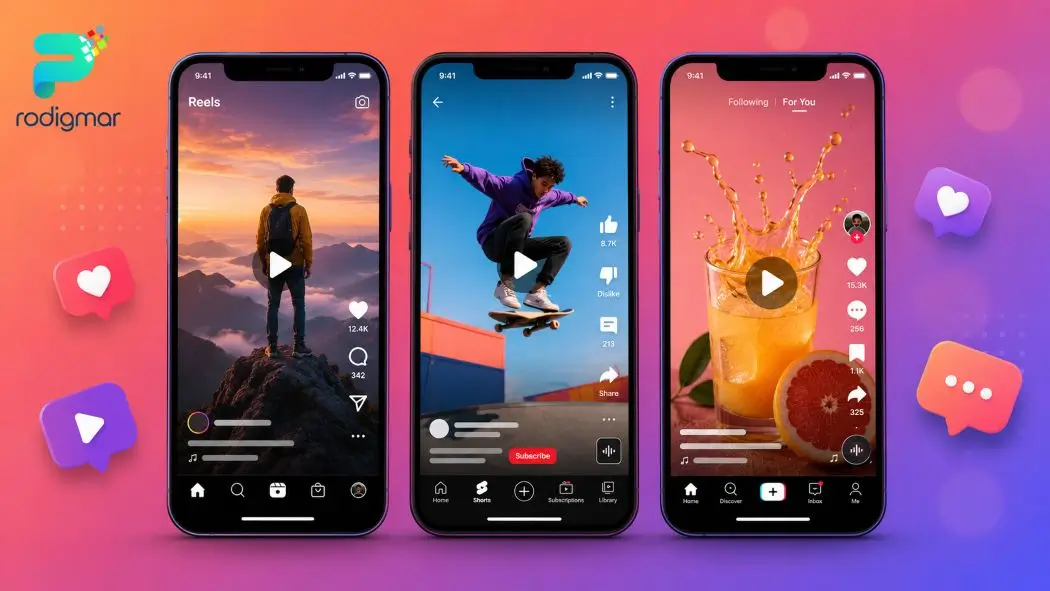
Short-form video remains the format marketers lean on hardest. Roughly 91% of businesses use video as a marketing tool in 2026, and short-form specifically is rated the highest-ROI content format by close to half of marketers surveyed by HubSpot.
But “short-form video works” doesn’t mean “post the same 15-second clip everywhere.” YouTube Shorts, TikTok, and Instagram Reels reward different pacing, different aspect ratios, and different creative instincts. A clip built for TikTok’s fast-cut energy often falls flat as a YouTube Short, and vice versa. Treating all three as one distribution channel wastes the format’s biggest advantage: platform-native reach.
Consumers have also made their preference clear. When asked how they’d rather learn about a product, most people choose a short video over a blog post or a sales call, per Wyzowl’s annual survey. If your product pages are still text-only, that’s a gap worth closing.
Here’s a pattern we see constantly: a business runs a great email campaign, a decent SEO strategy, and scattered social posts, but none of them reference each other. The customer experiences three disconnected brands instead of one coherent one.
Omnichannel marketing fixes this by making sure your email, social, paid, and organic content tell a consistent story and hand customers off smoothly between channels. It sounds obvious. Very few businesses actually do it well.
Content personalization is the other lever worth pulling. Dynamic landing pages and segmented email flows that adjust based on visitor behavior consistently outperform one-size-fits-all pages. You don’t need a massive AI budget to start, even basic segmentation (new visitor vs. returning customer, for example) moves the needle
Digital marketing trends move fast, and DIY-ing all of it, SEO, PPC, AI tools, social, content, isn't realistic for most businesses. Prodigmar helps businesses cut through the noise with a strategy built around what's actually working right now.
Talk to a Prodigmar Strategist →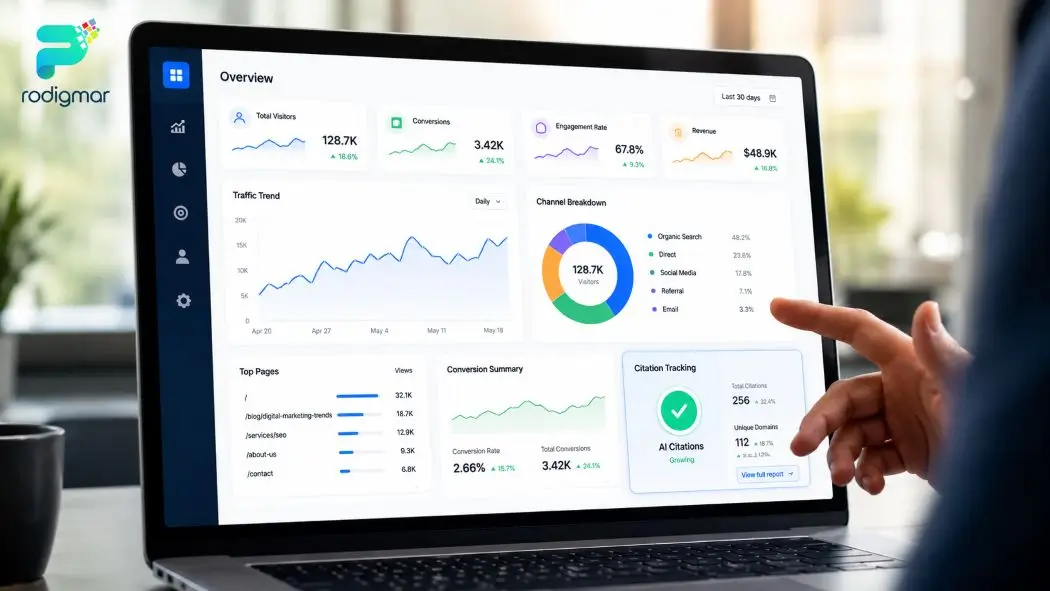
Here’s an uncomfortable truth: raw traffic numbers matter less than they used to. A page can inform thousands of AI-generated answers a day without registering a single session in your analytics dashboard. That’s not a bug in your tracking, it’s just how zero-click search works now.
Smart marketers are widening what they measure:
If your reporting still stops at “sessions and bounce rate,” it’s time for an upgrade.
| Customer Journey Stage | Primary Channels | Goal | Example Touchpoint |
|---|---|---|---|
| Awareness | Social media, organic SEO, short-form video | Get discovered by new audiences | A short-form video or blog post answering a common question |
| Consideration | Email nurture, retargeting ads, content marketing | Build trust and stay top of mind | A follow-up email with a case study or comparison guide |
| Conversion | Landing pages, PPC (Performance Max, Search) | Turn interest into action | A targeted landing page matching the ad's exact offer |
| Retention | Email marketing, loyalty programs, personalized offers | Keep customers coming back | A post-purchase email sequence with relevant upsells |
Digital marketing in 2026 rewards businesses that adapt their strategy to how people actually search, watch, and buy today, not how they did it in 2022. AI Overviews, Performance Max, first-party data, and short-form video aren’t passing fads. They’re the new baseline.
The businesses pulling ahead aren’t necessarily the ones with the biggest budgets. They’re the ones willing to rethink their approach instead of running the same playbook and hoping the algorithm forgives them.
Every business is different. Book a free 1-on-1 consultation with a Prodigmar strategist and get a custom social media growth plan built around your goals, your budget, and your audience.
Click to chat
No spam. No commitment. Just real insights.
We’ll contact you on WhatsApp about your audit. No commitment required.
No spam. No commitment. Just real insights.
We’ll contact you on WhatsApp about your audit. No commitment required.