Your ad budget has a job.
It should reach the right buyer, make the offer clear, and bring back more money than it burns. That sounds simple until you’re staring at TikTok Ads Manager, Meta Ads Manager, and a dozen half-finished video ideas.
The TikTok ads vs Instagram ads debate usually gets framed as a popularity contest. That’s lazy. The better question is commercial: which channel gives your business a better shot at profitable attention?
For most brands, TikTok is the better bet for fast discovery, creator-style video, and products that need a quick visual hook. Instagram is stronger for brands with polished visuals, warmer audiences, retargeting depth, and shopping behavior that already fits the Meta ecosystem.
Your best choice depends on your offer, your content, your margins, and your patience.
TikTok is a sound-on, full-screen, scroll-heavy platform.
Users aren’t searching. They’re reacting.
That means:
In most underperforming ads, the problem is the opening:
High-performing ads do the opposite:
They start mid-action and feel like content—not advertising.Choose TikTok if your product can be explained in 5 seconds, demonstrated on camera, or sold through social proof. Beauty, fashion, fitness, gadgets, food, apps, and impulse-buy products often fit well.
Choose Instagram if your brand already has clean visual assets, social proof, product photos, Reels, testimonials, and a buyer who needs a bit more trust before clicking.
Both can work. The difference is the kind of creative each channel rewards.
TikTok punishes ads that feel stiff. Instagram punishes ads that feel careless. That single sentence can save you a lot of wasted spend.
TikTok Ads Manager lets advertisers set a campaign objective, choose an audience, set bid and daily spend, and pick the video creative used in the campaign. TikTok’s current ad setup also supports single video, carousel, and collection ads.
Instagram ads run through Meta’s ad system. Instagram can place ads in surfaces such as Feed, Stories, Reels, Search, and Shops depending on the campaign setup, and Meta Ads Manager can publish across Facebook, Messenger, Instagram, WhatsApp, and Meta Audience Network.
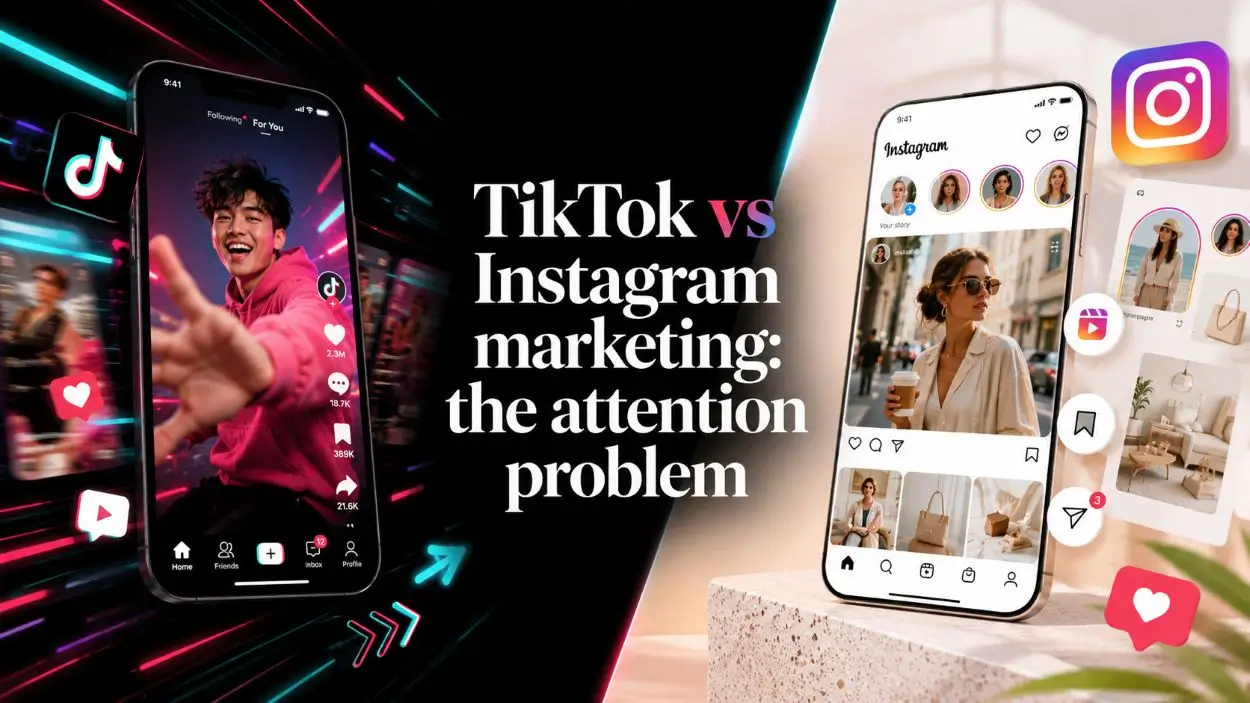
TikTok vs Instagram marketing starts with user intent.
People open TikTok to be entertained, surprised, taught, or pulled into a trend. The feed is fast. The first second matters. A slow product intro dies before the logo appears.
Instagram has more mixed behavior. People scroll Reels, check Stories, browse profiles, save posts, message brands, and revisit shops. The buying path can be longer, but the trust layer is often thicker.
That changes the ad creative.
A TikTok ad should feel like native content. It needs motion early, a sharp opening line, and a real person or product action. The script can be rough if the idea is strong.
An Instagram ad can be more polished. It still needs speed, but it can carry better brand design, product photography, testimonial overlays, before-and-after content, and creator clips with cleaner editing.
So, for a social media ads comparison, start with this test: can your product survive a raw video demo? If yes, TikTok deserves a test. If your product sells better through brand trust, social proof, or a catalog-style path, Instagram may be the safer first move.
Audience fit is where many campaigns get expensive.
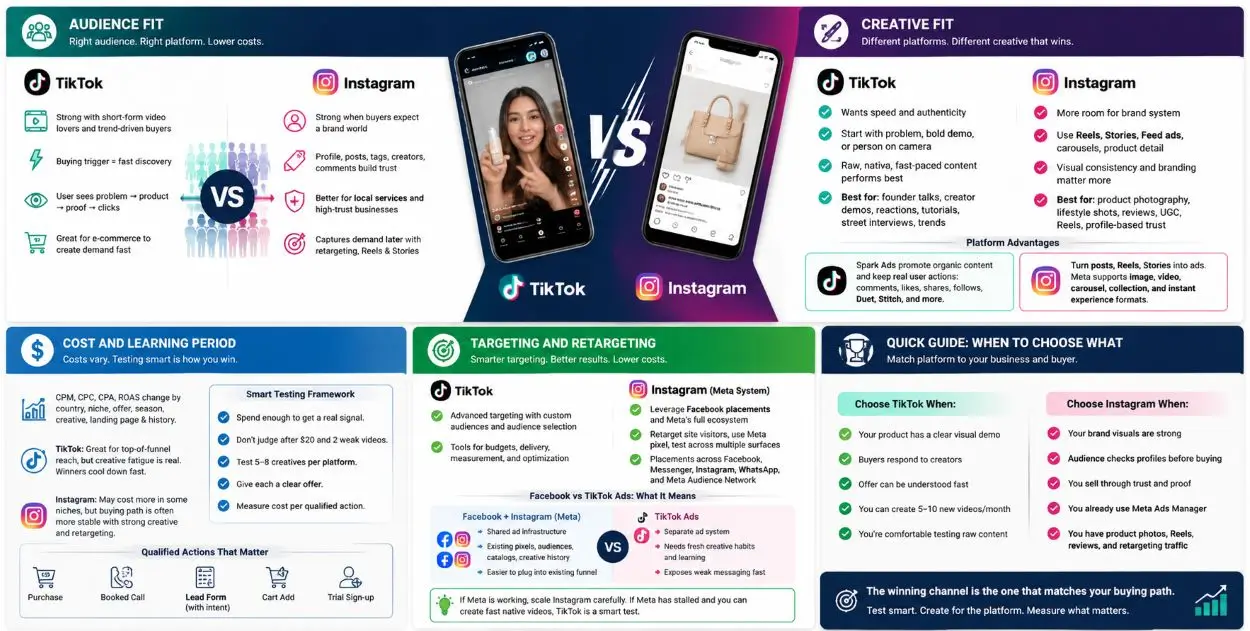
TikTok is strong when your buyer reacts to short-form video and trends. That doesn’t mean TikTok is only for teenagers. It means the buying trigger often comes from fast discovery. A user sees a problem, sees the product, sees proof, and clicks.
Instagram is strong when your buyer expects a brand world. A good profile, consistent posts, tagged products, creator partnerships, and comments all matter. The ad may start the sale, but the profile often helps close it.
Local services can use both, but Instagram usually has the edge when trust matters. Think clinics, real estate teams, salons, wedding services, gyms, coaches, and boutique stores. People want to inspect the brand before they give up a phone number.
For e-commerce, TikTok can create demand faster. Instagram can catch that demand later through retargeting, Reels, Stories, and product-based ads.
Creative is the real separator in TikTok ads vs Instagram ads.
TikTok wants speed. A strong TikTok ad often starts with the problem, a bold product demo, or a person speaking directly to the camera. It can look shot on a phone because that format matches the feed.
Instagram gives you more room for a brand system. You can use Reels for discovery, Stories for urgency, Feed ads for product detail, and carousel ads for multiple angles. Visual consistency matters more here.
A simple test:
If your best content is a founder talking, creator demos, reactions, tutorials, street interviews, or trend-based videos, start with TikTok.
If your best content is product photography, lifestyle shoots, customer reviews, UGC, Reels, and profile-based trust, start with Instagram.
Spark Ads are one reason TikTok works well for creator-style content. TikTok says Spark Ads let advertisers promote organic content while keeping normal user actions such as comments, likes, shares, profile visits, follows, Duet, and Stitch.
Instagram has its own advantage: you can turn existing posts, Reels, or Stories into ads, and Meta’s system lets advertisers use formats such as image, video, carousel, collection, and instant experience for traffic campaigns
Cost is the messiest part of any social media ads comparison.
CPM, CPC, CPA, and ROAS change by country, niche, offer, season, creative quality, landing page, and account history. A cheap click can still be useless. An expensive click can still be profitable.
TikTok often looks attractive for top-of-funnel reach. It can bring a lot of fresh attention when the video hits. The risk is creative fatigue. A TikTok winner can cool down fast, so you need more new concepts.
Instagram may cost more in some niches, especially competitive ones, but the buying path can be more stable if your account has good creative, clean tracking, and strong retargeting pools.
For a small business, I’d judge cost this way:
Spend enough to get a real signal. Don’t judge either channel after $20 and 2 weak videos. Test 5 to 8 creatives per platform, give each a clear offer, and measure cost per qualified action.
Qualified action matters. A purchase, booked call, lead form with intent, cart add, or trial sign-up tells you more than likes.
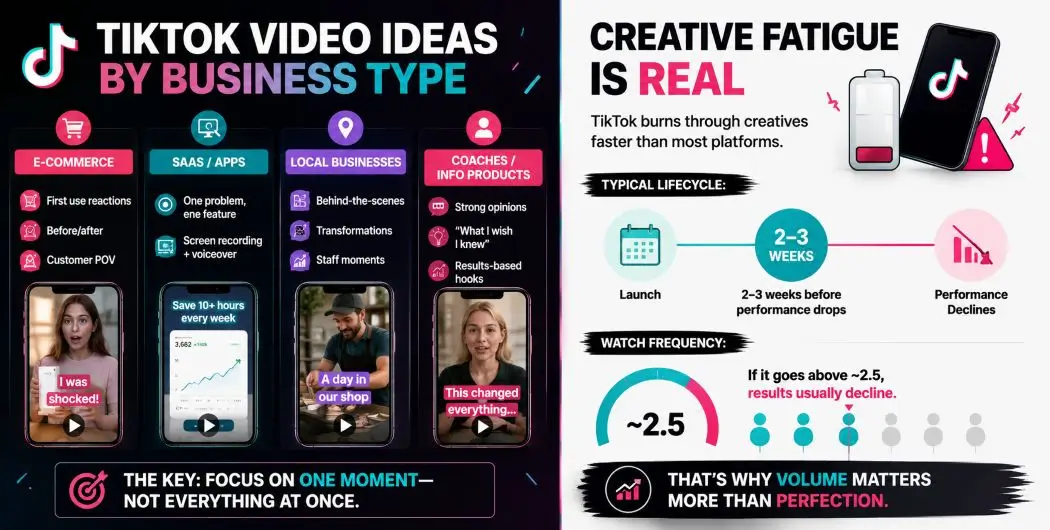
TikTok’s targeting has improved, and its ad system gives advertisers tools for custom audiences, audience selection, budgets, delivery, and measurement.
Instagram benefits from the wider Meta system. When you run Instagram through Meta Ads Manager, you can also connect Facebook placements, retarget site visitors, use existing Meta pixel history, and test across several surfaces in one account setup. Meta states that ad placements can run across Facebook, Messenger, Instagram, WhatsApp, and Meta Audience Network.
This is where the facebook vs tiktok ads discussion matters.
Facebook and Instagram share Meta’s ad plumbing. For businesses that already run Facebook campaigns, Instagram usually plugs into an existing structure. You may already have pixel events, audiences, catalogs, creative history, and remarketing groups.
TikTok may need fresh creative habits and fresh learning. That can be good. It can also expose lazy messaging fast.
If you already have a working Meta funnel, add Instagram carefully before shifting budget away. If Meta has stalled and your creative team can produce fast native videos, TikTok is a real test.
A good instagram ads strategy starts with the buyer stage.
Use Reels for reach and product proof. Keep the first 2 seconds active. Show the product, the result, or the person behind the claim.
Use Stories for direct response. Short copy. Clear offer. One call to action. Don’t make people decode the ad.
Use Feed ads when the product needs more visual detail. This works for apparel, furniture, beauty, food, travel, and anything where the buyer wants to inspect the look.
Use carousel ads when objections come in layers. One card can show the product. Another can show proof. Another can show sizing, pricing, or the offer.
Then clean up the profile. This part gets skipped too often. If the ad sends people to a profile that looks abandoned, you’re paying for doubt.
Your bio, pinned posts, product tags, reviews, and recent content should all support the ad promise. The click is only one step. The profile has to carry its weight.
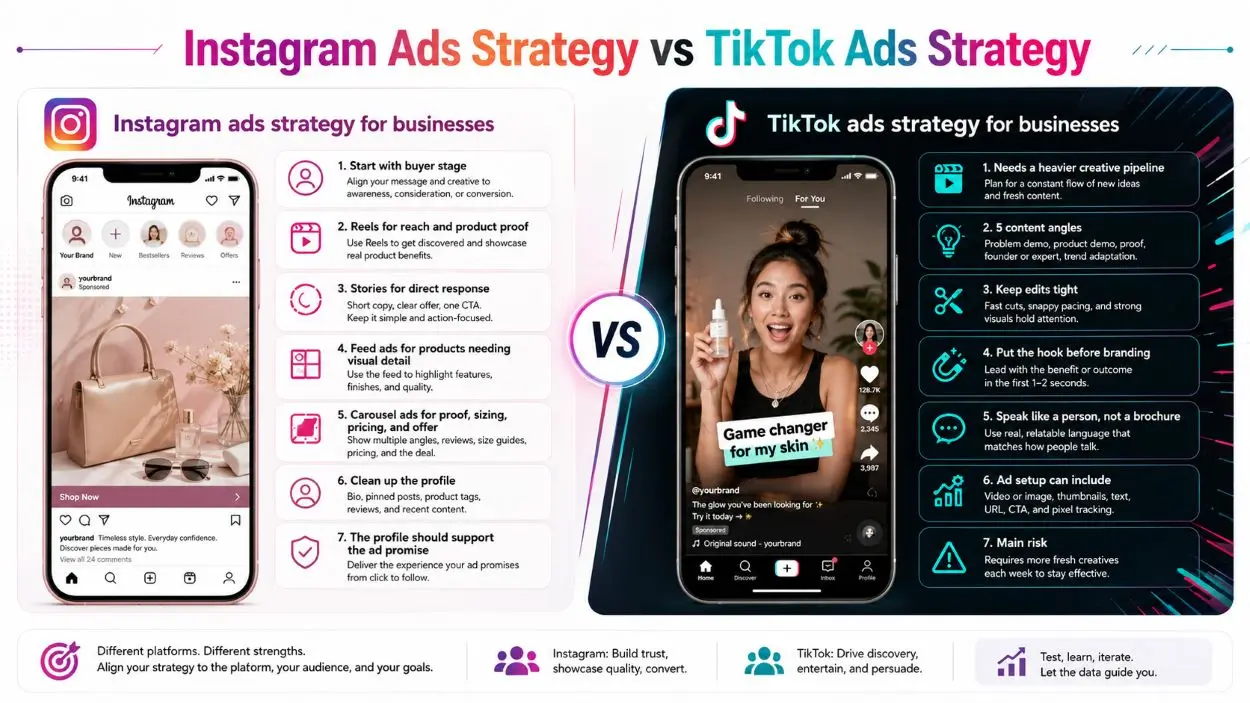
TikTok needs a heavier creative pipeline.
Start with 5 content angles:
Problem demo. Show the pain your buyer knows.
Product demo. Show the product doing the thing.
Proof. Show reviews, reactions, creator clips, or side-by-side results.
Founder or expert explanation. Use a person with a real point of view.
Trend adaptation. Use a current format only when it fits the product.
Keep the edits tight. Put the hook before the branding. Speak like a person, not a brochure.
TikTok’s ad creation flow lets advertisers add videos or images, choose thumbnails, set text, add URLs, select a call to action, and use tracking URLs or TikTok Pixel.
The main risk is volume. TikTok can demand more creative testing than a small team expects. If you can’t produce new videos each week, the platform may run out of fresh angles quickly.
Here’s the cleanest platform comparison ads framework for a business owner.
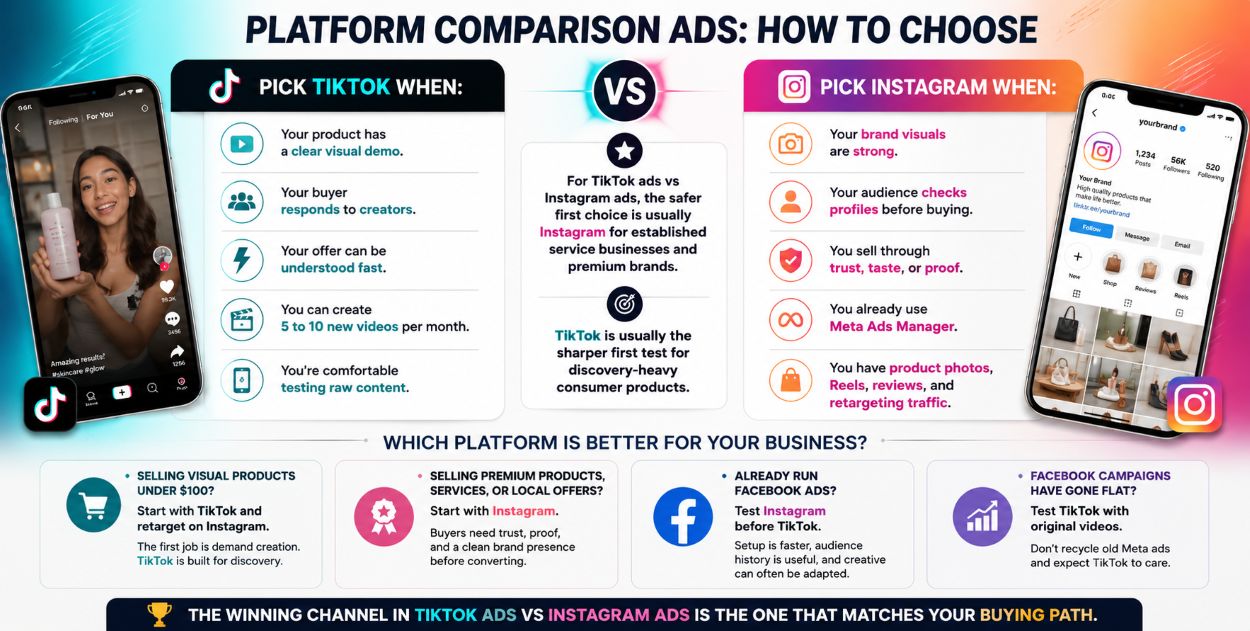
Pick TikTok when:
Your product has a clear visual demo.
Pick Instagram when:
You have product photos, Reels, reviews, and retargeting traffic.
For TikTok ads vs Instagram ads, the safer first choice is usually Instagram for established service businesses and premium brands. TikTok is usually the sharper first test for discovery-heavy consumer products.
Here’s my direct take.
If you sell a visual product under $100, start with TikTok and retarget on Instagram. The first job is demand creation. TikTok is built for that kind of discovery.
If you sell a premium product, service, consultation, or local offer, start with Instagram. The buyer will likely need trust, proof, and a clean brand presence before converting.
If you already run Facebook ads, test Instagram before TikTok. The setup is faster, the audience history is useful, and your creative can often be adapted.
If your Facebook campaigns have gone flat, test TikTok with original videos. Don’t recycle old Meta ads and expect TikTok to care.
The winning channel in tiktok ads vs instagram ads is the one that matches your buying path.
The first mistake is using the same creative on both platforms.
A polished Instagram product video can feel too slow on TikTok. A rough TikTok clip can feel too thin on Instagram if the product needs trust.
The second mistake is judging the channel before testing enough ads. One weak video tells you almost nothing.
The third mistake is chasing cheap traffic. Cheap traffic can fill reports and empty your wallet at the same time.
The fourth mistake is skipping the landing page. If the page is slow, vague, or cluttered, both platforms will look worse than they are.
The fifth mistake is ignoring comments and DMs. On both channels, buyers ask questions before buying. A fast reply can rescue a sale that ads alone would lose.
Prodigmar can help you plan, build, and manage paid social campaigns across TikTok, Instagram, and Meta. We’ll review your offer, pick the right channel mix, write the ad angles, and set up a testing plan that makes sense for your budget.
Book a paid social audit with Prodigmar and find out which platform should get your next ad dollar.
Click to chat