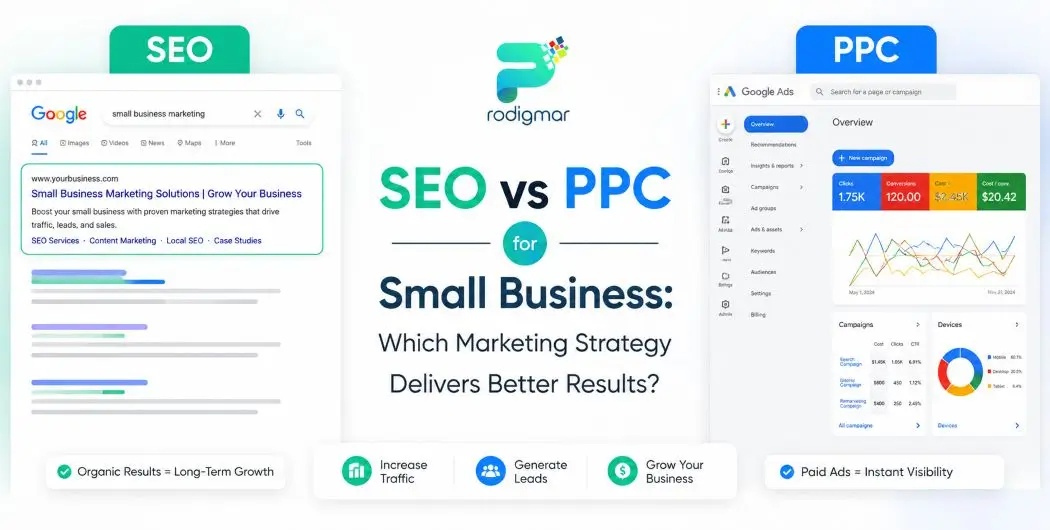
You have a limited budget. You have big growth goals. And Google is sitting there with two very different doors — one that costs you money every time someone knocks, and one that takes time but eventually runs itself.
That, in a nutshell, is the SEO vs PPC debate for small businesses. It is one of the most common questions business owners ask when they start thinking seriously about digital marketing. Should you invest in search engine optimisation and build organic rankings over time? Or do you launch a Google Ads campaign and start getting leads this week?
The honest answer is: it depends. But “it depends” without context is useless — so this guide exists to give you that context. We will break down the real costs, realistic timelines, ROI comparisons, and a clear decision framework so you can choose the right digital marketing strategy for where your business is right now.
Search engine optimisation (SEO) is the process of improving your website so it shows up in Google’s organic search results. No paid ads. No bidding wars. Just your website earning its position because Google considers it relevant and trustworthy for a given search query.
For a small business, SEO covers several moving parts: on-page content optimisation, technical website health, local SEO for location-based searches, and building backlinks from other credible websites. Think of it as building a reputation online – slow, sometimes frustrating, but genuinely valuable once it takes hold.
The biggest advantage of SEO is compounding value. Once a page ranks well, it keeps bringing in traffic without you paying per click. That is something paid advertising simply cannot do.
This is the question every business owner asks – usually right after being told SEO is the better long-term play.
Realistically, most small businesses start seeing measurable movement in organic rankings between three to six months. Strong, competitive first-page rankings typically take nine to twelve months, sometimes longer in highly competitive industries.
The timeline depends on your domain’s existing authority, how competitive your target keywords are, the quality of your content, and how consistently you build backlinks. A brand-new domain with no history will take longer than an established site that has been around for years.
The good news? Once you rank, those rankings deliver traffic for free — every single day.
Pay-per-click advertising (PPC) means you pay Google every time someone clicks your ad. The most common platform is Google Ads, where businesses bid on keywords and their ads appear at the top of search results – clearly marked as “Sponsored.”
The mechanics are straightforward. You set a daily budget, choose your keywords, write your ad copy, and Google enters you into an auction. Your ad position depends on your bid price and a quality score based on your ad relevance and landing page experience.
PPC’s superpower is speed. A campaign can go live and start generating clicks the same day. For a new business with no organic rankings whatsoever, that kind of immediate visibility is genuinely hard to dismiss.
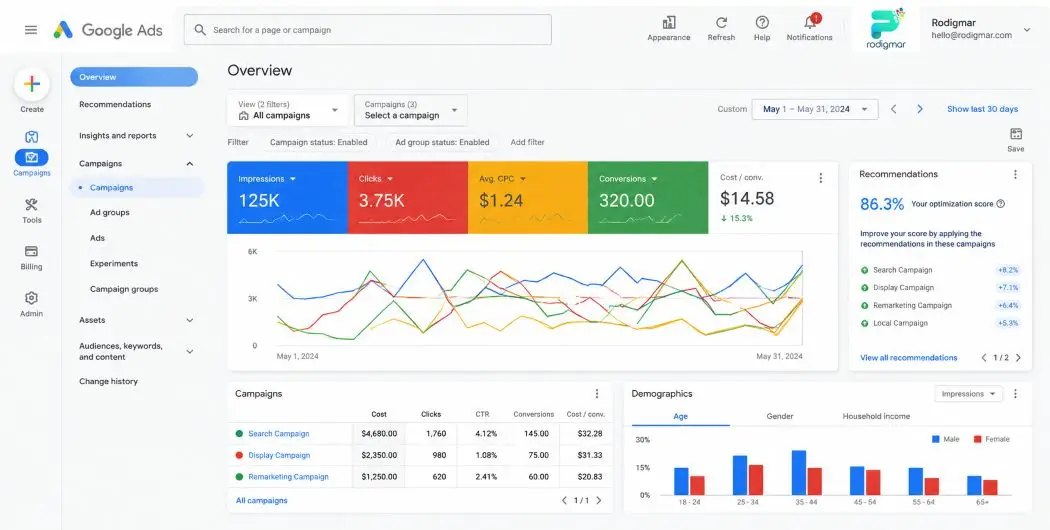
There is no magic number, but there is a practical minimum. You need enough budget to generate a statistically meaningful number of clicks before you can judge whether a campaign is working. Most digital marketers suggest a starting point that allows for at least 100 to 200 clicks per month — enough to see real conversion data.
The catch is that cost-per-click (CPC) varies enormously by industry. According to WordStream’s 2025 Google Ads Benchmarks report, which analysed over 16,000 campaigns, the average CPC across all industries reached $5.26 – and it is rising.
| Industry | Avg. CPC (Google Ads, 2025) | Notes |
|---|---|---|
| Legal Services | $70–$250 per click | Highest CPCs of any industry |
| Finance / Insurance | $15–$40 | Very competitive keywords |
| Home Services (HVAC, plumbing) | $6–$15 | Strong local intent |
| Retail / eCommerce | $1–$5 | Volume-driven campaigns |
| General Average (all industries) | $5.26 | WordStream 2025 Benchmarks |
Landing pages matter just as much as the ad itself. Sending PPC traffic to a generic homepage is one of the most common – and expensive – mistakes small businesses make.
Our team at Prodigmar builds custom SEO and PPC strategies for small businesses. Let us look at your goals and tell you exactly where to start.
Get a Free Strategy Consultation →This is where most comparisons get oversimplified. People say “SEO is free” and “PPC is expensive.” Neither is quite right.
SEO has real costs – content creation, technical optimisation, link building, and ongoing maintenance. You either invest your own time or pay an agency. The key difference is that your investment builds an asset. A well-ranked page keeps driving traffic long after the work is done.
PPC is pay-as-you-go. The moment your budget runs out, your ads disappear and your traffic drops to zero. You are essentially renting visibility rather than owning it.
| Factor | SEO | PPC |
|---|---|---|
| Upfront cost | Medium–High (content, technical work) | Low (set a budget and go) |
| Ongoing cost | Low–Medium (maintenance, updates) | High (you pay per click, always) |
| Time to results | 3–12 months | Hours to days |
| Traffic when you stop | Continues (rankings persist) | Stops immediately |
| Long-term value | Compounds over time | Flat — tied to budget |
| Best for | Sustainable growth | Quick launches, seasonal pushes |
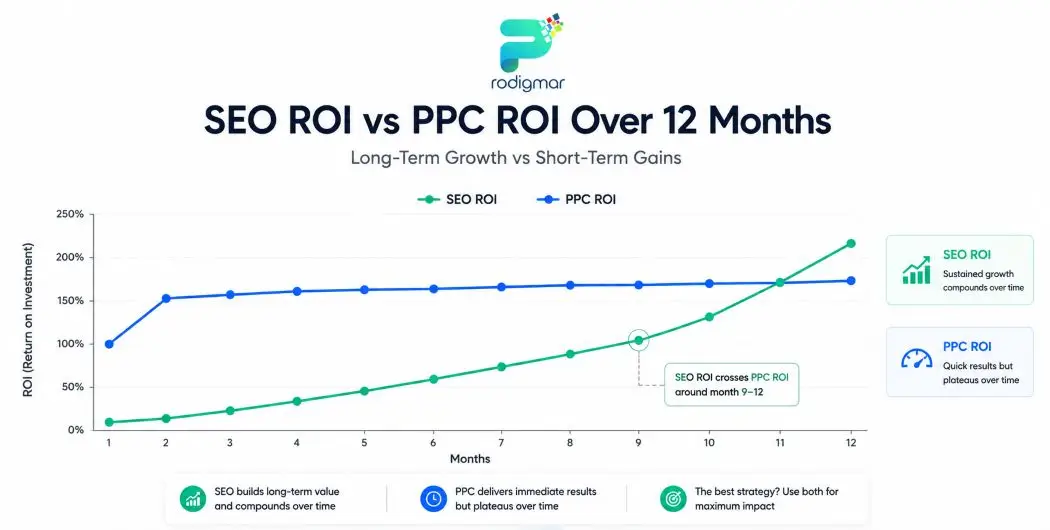
The break-even point – where your SEO investment starts delivering more value than equivalent PPC spend – usually arrives somewhere between 12 and 18 months. Before that point, PPC often wins on raw cost-per-lead. After it, SEO tends to pull ahead significantly.
ROI is where the conversation gets interesting – and a little complicated. Because the answer genuinely changes depending on your time horizon.
In the first three months, PPC almost always wins. You are paying for qualified clicks, your ads are live, and leads can start coming in week one. 22% of businesses see higher ROI from PPC within the first three months — but that advantage narrows significantly over time.
After nine months, the picture flips. 63% of marketing leaders confirm that SEO delivers higher ROI than PPC after nine months. Organic traffic keeps arriving without ongoing ad spend, which dramatically lowers your cost-per-lead over time.
Here is a real-world illustration. A SaaS startup spent $8,000 on PPC in one quarter, averaging $160 per lead. Their parallel SEO investment of $5,000 started slowly – but by month six, leads were coming in at $70 per conversion. The SEO channel cut their cost-per-lead in half.
Conversion rates also tell an interesting story. Organic search has a 14.6% average conversion rate, while PPC sits at around 10% – meaning organic visitors tend to convert at a higher rate, possibly because they trust organic results more than paid ads.
There is one important nuance here: PPC ROI is easier to measure in the short term because every click and conversion ties directly to a campaign. SEO ROI takes longer to calculate but tends to be larger once the compounding effect kicks in.
Lead generation is where the two channels behave very differently — and where your choice of channel needs to match your business model.
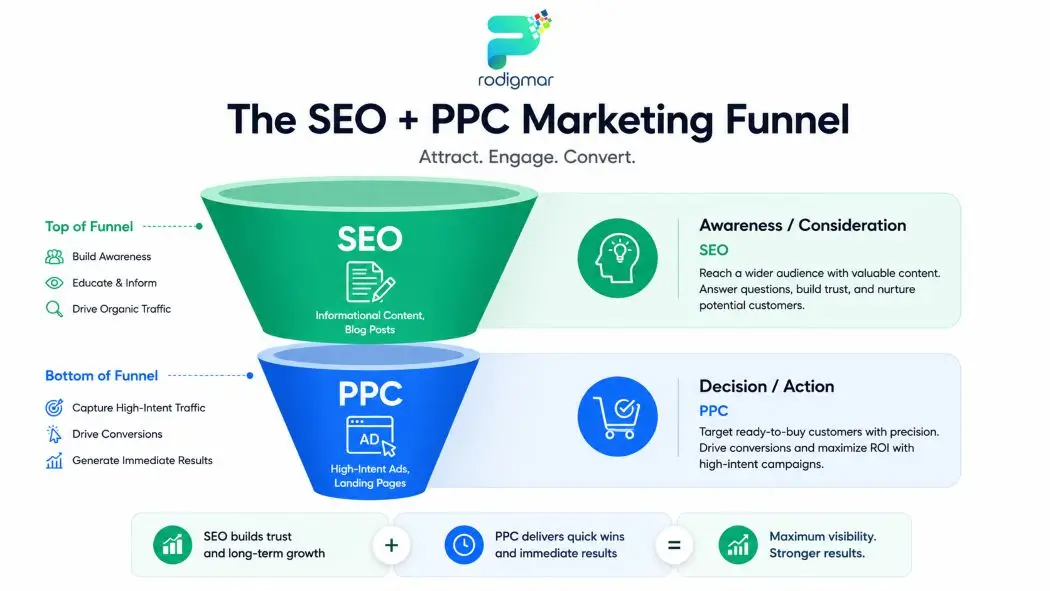
PPC is brilliant for capturing high-intent, bottom-of-funnel demand instantly. If someone types “emergency plumber Melbourne” into Google, they need someone now. A Google Ad captures that moment perfectly. A Florida plumbing company added PPC targeting “emergency plumber near me” alongside their existing SEO strategy, and their call volume doubled within weeks — with cost per lead dropping to $42. The combination of urgency-targeting through PPC and credibility-building through SEO proved more powerful than either alone.
SEO, on the other hand, tends to generate leads across a wider range of the customer journey. Someone researching “best bathroom renovation ideas” is earlier in their decision. You can capture them with useful content, build trust over multiple visits, and convert them when they are ready. These leads often come with higher lifetime value.
| Your Situation | Recommended Approach |
|---|---|
| New website, need leads fast | Start with PPC → build SEO alongside |
| Established site, limited budget | Focus on SEO → add PPC for top-priority keywords |
| Seasonal business | PPC during peak season + SEO year-round |
| Content-driven or service business | SEO-led strategy with targeted PPC campaigns |
| Competitive market, need both | Integrated SEO + PPC (75% SEO / 25% PPC long-term) |
| Startup testing demand | PPC first to validate, then invest in SEO |
Absolutely – and it is often the smartest move. The two channels are not competitors. They are different tools that solve different problems.
A combined approach works like this: PPC fills the revenue gap in the short term while your SEO matures. Once your organic rankings start producing consistent traffic, you can gradually shift budget from PPC into content and link building. Meanwhile, your PPC conversion data tells you exactly which keywords are worth chasing organically.
One practical benefit of running both is SERP domination. When your business appears in both the paid and organic results for the same query, users see you twice on the same page. That double presence builds trust and significantly increases the likelihood of a click.
Prodigmar builds integrated search engine optimisation and PPC management strategies for small businesses — ensuring both channels work together, not in isolation
Whether you need SEO, Google Ads, or both - Prodigmar's small business marketing team will build a strategy around your budget and goals. No jargon. No fluff.
Talk to a Prodigmar Strategist →The SEO vs PPC debate does not have a winner – it has a context. PPC wins when you need speed, flexibility, and immediate control over who sees your business. SEO wins when you play the long game, want compounding returns, and prefer not to pay for every single visit indefinitely.
For most small businesses, the smart path is not choosing one or the other – it is understanding when to lean on each. Start with PPC to generate revenue while your domain builds authority. Then use the data that PPC gives you to fuel a smarter, more targeted SEO strategy. Over time, organic traffic takes the weight, and your paid spend becomes a precision tool rather than a lifeline.
That is the kind of integrated digital marketing strategy Prodigmar builds for small businesses every day. If you want to stop wondering which channel is right for you and start getting real answers, our team is ready to help.
Get in touch with Prodigmar — let’s build something that actually grows your business.

Every business is different. Book a free 1-on-1 consultation with a Prodigmar strategist and get a custom social media growth plan built around your goals, your budget, and your audience.
Click to chat
No spam. No commitment. Just real insights.
We’ll contact you on WhatsApp about your audit. No commitment required.
No spam. No commitment. Just real insights.
We’ll contact you on WhatsApp about your audit. No commitment required.