

SEO for retail businesses helps customers discover relevant products, stores and buying information through unpaid search results. It connects what people search for with pages that help them decide what to buy and where to buy it.
For Pakistani retailers, that might mean a showroom visit in Lahore, an online clothing order or a salon appointment.
Start with accurate information and a usable website. Your shop may have beautiful lighting, but Google still needs more directions than “next to the famous chai place.”
Key Takeaways
- Match customer searches to useful product, category and location pages.
- Keep your business identity, stock information and customer policies accurate.
- Build AI visibility on accessible, credible content; no one can guarantee citations.
1. Match Search Intent to the Right Page
Search intent describes what someone wants to accomplish. Retail SEO should support that task instead of sending every visitor to the homepage.
These illustrative searches are not verified search-volume data.
| Example Search | Customer Need | Suitable Page |
|---|---|---|
| “cotton bedsheets online Pakistan” | Browse and buy | Bedsheets category |
| “three-seater sofa dimensions” | Evaluate an item | Detailed product page or buying guide |
| “furniture showroom Lahore” | Find somewhere to visit | Genuine showroom page |
| “how to choose curtain fabric” | Understand options | Practical buying guide |
Start with customer questions, website searches and queries in Google Search Console. Group similar needs and assign each group a useful destination.
Explore English, Urdu and Roman Urdu wording when customers use it. Validate demand before building pages around every variation.
2. Build a Website Structure Customers Can Follow
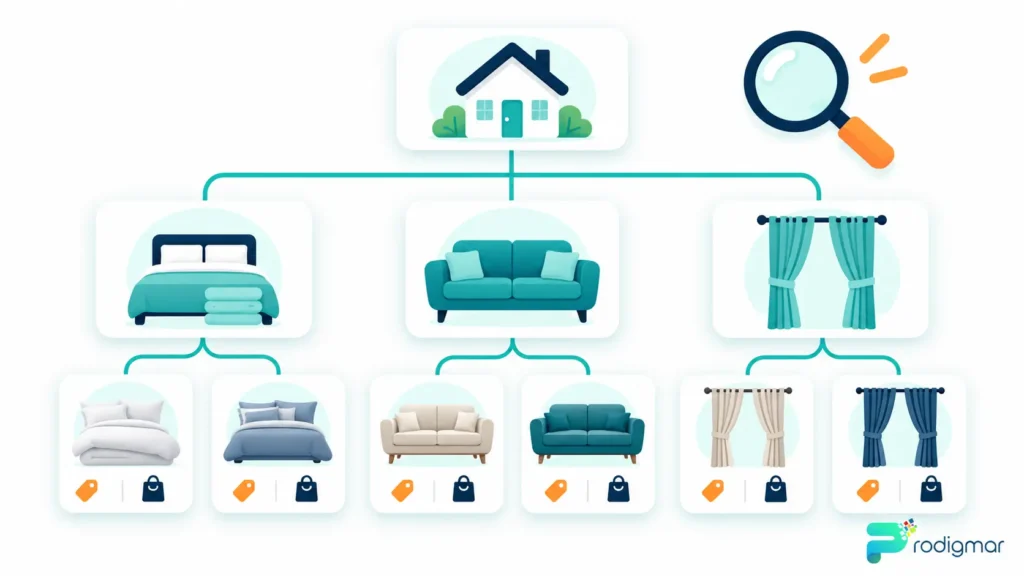
Organise your shop into understandable categories and subcategories, then link to individual products.
For example: Home → Bedding → Bedsheets → Cotton bedsheet set.
Google’s e-commerce navigation guidance recommends links through this hierarchy. Products available only through an internal search box may escape discovery through normal crawling.
Use descriptive navigation labels and relevant internal links. A curtain buying guide can link to curtain categories; a product page can link to its care instructions.
Give each important page a descriptive title and clear main heading. Write a useful meta description rather than squeezing in every keyword you own.
3. Make Product and Category Content Useful
Product page SEO starts with the details a customer needs to buy confidently.
Include accurate materials, measurements, available options, prices, stock status and delivery information. Explain returns or exchanges clearly.
Use original photographs where possible. Describe meaningful images with concise alt text; avoid repeating location keywords in every description.
Give Category Pages a Buying Role
A category page should help visitors choose between products. Explain relevant differences, such as fabric, size, intended use or care requirements, without burying the product grid under an essay.
For a bedsheet retailer, a short comparison of available materials may answer more questions than another paragraph about “premium quality.”
Google’s people-first content guidance prioritises useful, reliable information. Add knowledge your team can substantiate, including actual product details and answers from customer conversations.
4. Improve Local Discovery With Google Business Profile

For an eligible physical shop or service business, Google Business Profile supports discovery through Maps and local Search.
Google’s eligibility guidelines exclude online-only businesses. Do not invent a storefront to obtain a listing.
For a qualifying business:
- Verify the profile and use your real business name.
- Select categories that accurately describe the business.
- Keep contact details, opening hours and holiday hours current.
- Add genuine photographs of the entrance, products and interior.
- Respond professionally to customer reviews.
Google explains that local ranking mainly considers relevance, distance and prominence. Complete information helps communicate relevance, but you cannot remove the distance between your shop and a searcher.
Ask customers for honest feedback without purchasing reviews or inventing testimonials.
Create Genuine Location Pages
For each real branch, publish its address, hours, contact details and useful visiting information. Add location-specific photographs and explain what customers can find there.
A delivery area is not automatically a branch. Avoid cloning the same page for Lahore, Karachi and Islamabad when only the city name changes.
Get Your Free Retail Growth Audit
Can customers find your shop but struggle to understand your products or next step? Share your website, location and main challenge with Prodigmar. Request a review to help identify your next SEO priorities.
Request Your Free Retail Growth Audit5. Make Your Business Identity Easy to Verify
Show who operates the business and how customers can contact you.
Keep your name, address where applicable, phone number and website information consistent across your own pages and relevant listings. Explain delivery coverage, payment options and customer support clearly.
Add an honest About page. Name authors or reviewers where their experience helps readers evaluate advice. Support claims about materials, sourcing or warranties with information you can demonstrate.
Different sectors need different buying details. Prodigmar’s retail industries overview shows the categories its services address.
6. Fix Technical Barriers Before Publishing More
Google’s technical requirements include allowing Googlebot access, returning a successful response and providing indexable content. Meeting these requirements does not guarantee indexing.
Ask your developer to check:
- Important pages do not carry accidental noindex instructions.
- Security rules and robots.txt do not block intended crawling.
- Mobile navigation, product options and checkout work.
- Canonical tags identify the intended versions of duplicate pages.
- The XML sitemap lists current, indexable canonical URLs.
Review filters and sorting URLs so they do not create unnecessary duplicate page sets. Compress images and investigate slow or unstable mobile pages.
After a redesign, map changed URLs to relevant replacements. Google’s migration guidance supports permanent redirects for moved content. Permanently removed pages without suitable replacements should return 404 or 410, rather than redirecting everything to the homepage.
7. Use Structured Data to Describe Real Content
Structured data adds machine-readable details to a page.
Google’s Product documentation explains how eligible product pages can communicate information such as price and availability. LocalBusiness markup can describe a physical business and its details.
Use the appropriate type, match it to visible information and test the implementation. Never invent ratings or mark unavailable products as in stock.
Schema supports understanding and eligibility for particular search appearances. It does not guarantee a rich result or higher rankings. Check each feature’s requirements separately.
8. Treat AI Visibility as Part of the Foundation

AI search visibility means appearing as a source or business reference within AI-generated answers.
Google’s AI search guidance says established SEO practices remain relevant. Supporting pages must be indexed and eligible for a search snippet. Google requires no special AI schema or additional AI text file for these features.
Make important facts available as readable text. Answer buying questions directly, use descriptive headings and maintain accurate product and business details.
A furniture retailer could explain measurements, materials and delivery limits clearly. That helps people assess the offer and gives retrieval systems concrete information to interpret.
Other platforms have their own access and selection rules. Do not assume Google’s requirements cover every AI service, or promise that a content format will earn citations.
9. Measure Discovery and Customer Outcomes
Use a manageable reporting framework:
| Area | What to Review |
|---|---|
| Search discovery | Relevant queries, impressions, clicks and landing pages |
| Local interest | Available profile interactions, including calls and directions |
| Online sales | Organic purchases, revenue, cancellations and returns |
| Enquiries | Qualified conversations, bookings and completed sales |
A direction request does not prove a store visit. A WhatsApp click does not prove a qualified lead.
Google includes AI-feature traffic in Search Console’s Web reporting. Track identifiable referrals separately; attribution remains incomplete.
Compare consistent periods and account for seasonal demand. Prioritise fixes that improve the journey from discovery to purchase.
Build Your Retail Growth Plan With Prodigmar
Need help deciding what to fix first? Prodigmar’s SEO services can support your search strategy within its wider retail marketing services in Pakistan. Bring your website and biggest discovery challenge to a focused conversation about practical next steps.
Book Your Retail Growth Strategy CallFrequently Asked Questions
Retail SEO improves how customers discover a store, its products and useful buying information through unpaid search. It combines relevant content, website structure, technical access and local visibility where applicable.
Local SEO supports discovery of nearby businesses and locations. E-commerce SEO focuses on online categories, products and buying journeys. Retailers with physical shops and online ordering often need both.
Google lists online-only businesses as ineligible. Check the current eligibility rules if your business also serves customers in person. Do not use a false address to create a profile.
No. Accurate markup can clarify information, but it cannot guarantee selection or citations. For Google’s AI search features, standard SEO foundations apply; no special AI schema is necessary.
Timing varies with competition, your starting point and the changes involved. Monitor indexing, relevant searches and customer outcomes over time. Avoid promises of immediate rankings or a fixed sales increase.