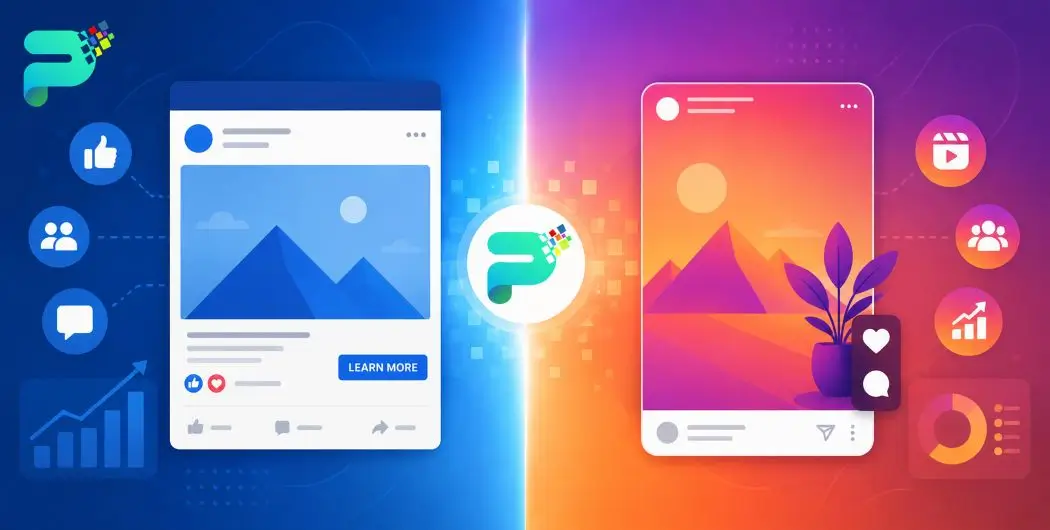
Every marketing meeting eventually hits this question: Facebook or Instagram? Someone on the team swears by Facebook leads. Someone else insists Instagram Reels convert better. Both are right, and both are also missing the bigger shift happening inside Meta’s ad platform right now.
This guide breaks down what actually differs between Facebook Ads and Instagram Ads in 2026, why the platform-vs-platform framing is becoming less useful, and how to make a decision that fits your business instead of a generic rule of thumb.
Facebook still wins for lead generation, B2B, and older audiences. Instagram still wins for visual products, younger buyers, and brand engagement. Nothing shocking there.
But here’s the twist most articles skip: Meta doesn’t want you choosing one platform anymore. Its own automation is built to place your ad wherever it performs best, often blending both platforms inside a single campaign.
That doesn’t make the comparison pointless. It changes what you should actually be comparing.
Meta’s Advantage+ Placements tool automatically distributes your ad across Facebook, Instagram, Messenger, and the Audience Network based on real-time performance signals. You don’t pick a placement. The algorithm picks it for you, ad auction by ad auction.
Meta’s own business page confirms the impact: <cite index=”15-1″>ad sets using Advantage+ placements saw an average CPA improvement of 11.7%</cite>. That’s not a marketing claim from an agency blog. That’s Meta reporting on its own system.
So when someone asks “should I run Facebook or Instagram,” the honest answer for most accounts in 2026 is: you’re probably running both already, and Meta is deciding the split for you.
This matters because it flips the real question. Instead of “which platform,” the smarter question becomes “which creative format.” Meta’s algorithm can move your budget between platforms in seconds. It cannot turn a Facebook-style static image into a Reels-native video. That part is still on you.

Automation handles placement. It doesn’t erase the underlying differences in who uses each platform and how they behave. These still shape your strategy.
Facebook holds a wider, older user base. Instagram skews younger and leans harder on visual discovery. If your offer needs explanation, a longer pitch, or trust-building before someone converts, Facebook’s audience tends to sit with that kind of content longer.
If your product needs to be seen to be understood, fashion, food, fitness, home décor, Instagram’s format naturally favors that.
Facebook generally delivers lower cost-per-click because its inventory and audience pool are larger. Instagram, especially in visually competitive niches like beauty or fashion, tends to run slightly higher on cost due to tighter competition for premium visual placements. Neither number stays fixed. Auction pricing shifts with your industry, creative quality, and season.
Facebook still leans toward direct-response formats: lead forms, carousel ads for multi-product catalogs, and longer-copy posts that support decision-making. Instagram leans toward Stories, Reels, and Explore placements built for scroll-stopping visuals rather than reading.
Neither platform is “better.” They’re built for different moments in a buyer’s journey.

Every account behaves differently once real audience data and creative testing enter the picture. Prodigmar's paid social team can audit your current Facebook and Instagram campaigns and show you exactly where your budget performs best, not where a blog post says it should.
Talk to Our Paid Social Team →Here’s the part most “Facebook vs Instagram” articles conveniently skip: the ROI numbers you’re comparing might already be wrong.
Since Apple’s App Tracking Transparency update, iPhone users can block cross-app tracking with one tap. Most do. That means the Meta Pixel, the tool responsible for reporting your conversions, misses a growing share of real purchases and leads. Your reported Facebook or Instagram ROI could be understating what’s actually happening.
Meta’s answer to this is the Conversions API (CAPI), a server-side connection that sends conversion data directly from your website’s backend to Meta, bypassing browser restrictions entirely. If you’re comparing Facebook and Instagram performance without CAPI running alongside your Pixel, you’re comparing incomplete data. Fix the measurement layer before you trust the platform comparison.
Skip the debate. Use this instead.
This turns a vague “which is better” debate into a repeatable process.
Broad advice only goes so far. Here’s a practical breakdown by business type.
| Industry Type | Platform Lean | Why |
|---|---|---|
| B2B services | Older, decision-making audience; supports longer-form lead content | |
| Home services (HVAC, renovation, roofing) | Homeowner demographic skews 35–55, matching Facebook's user base | |
| Fashion, beauty, lifestyle eCommerce | Visual discovery drives impulse and consideration purchases | |
| Matchmaking and relationship services | Both, weighted by audience age | Younger clients respond to Instagram; parents/family decision-makers respond to Facebook |
| B2B eCommerce | Facebook, supplemented by Instagram | Buyers research more before purchasing, favoring Facebook's format |
| Local service businesses | Native lead forms and geographic targeting keep cost-per-lead lower |

If your business straddles two categories, run both, but build separate creative for each. A single square image dropped into every placement is the fastest way to underperform on both platforms at once.

Building placement-specific creative and clean CAPI tracking from scratch takes time most business owners don't have. Prodigmar handles the setup, testing, and optimization so your ad spend goes toward results, not guesswork. Explore our social media marketing services or read how we generate qualified leads with Facebook Ads.
Get a Free Ad Account Review →
Facebook and Instagram aren’t really competitors anymore inside Meta’s own system. They’re two surfaces of the same advertising engine, and the platform increasingly decides the split for you. Your job isn’t picking a winner. It’s feeding the algorithm strong, placement-specific creative and clean tracking data, then reviewing the results instead of guessing.
Get those two things right, and the “Facebook vs Instagram” debate mostly answers itself.
You don’t need more likes - you need results.
Let’s build a system that generates leads, not just impressions.
Book Your Free Strategy Call Now →Click to chat