
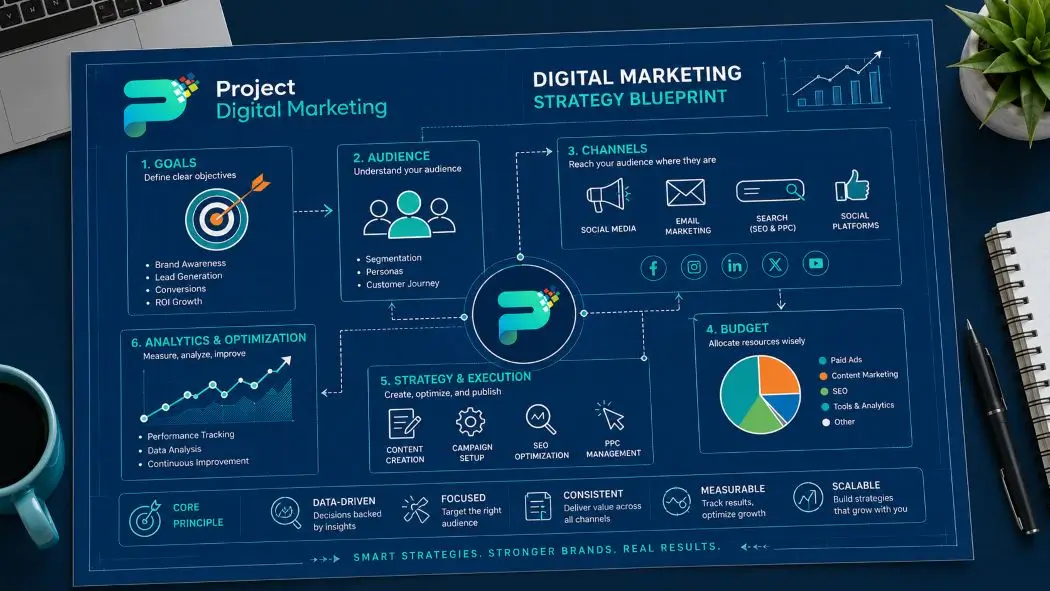
Most businesses don’t fail at marketing because they lack effort — they fail because they lack direction. Posting on social media, running the occasional ad, and sending out emails here and there might keep things busy, but without a clear plan tying it all together, results tend to be inconsistent at best. That’s where a digital marketing strategy blueprint comes in.
A blueprint isn’t just a list of tasks. It’s a structured framework that connects your business goals to the channels, content, and budget needed to reach them — and gives you a way to measure whether it’s actually working. Whether you’re a small business owner trying to make sense of where to focus, or a marketing team looking to bring more structure to your efforts, this guide walks through the core building blocks of a digital marketing strategy that holds up in the real world.
By the end, you’ll have a clear picture of how to define your goals, understand your audience, choose the right channels, plan your content, allocate your budget, and track performance — all as part of one connected strategy rather than a collection of separate activities. If you’d rather have a team handle the execution, Prodigmar’s full range of digital marketing services covers every piece of this blueprint.
Before diving into the steps, it helps to be clear on what we actually mean by a digital marketing strategy blueprint — and why so many businesses operate without one, often without realizing it.
A digital marketing strategy blueprint is a documented framework that outlines your business goals, target audience, chosen marketing channels, content approach, budget, and the metrics you’ll use to measure success. It’s the “why” and “how” behind your marketing — not just the “what.”
This is where the confusion between strategy and tactics often comes in. A tactic is a specific action — posting three times a week on Instagram, running a Google Ads campaign, sending a monthly newsletter. A strategy is the reasoning behind those actions: who you’re trying to reach, what you want them to do, and how each tactic contributes to that outcome. Tactics without strategy tend to produce activity without progress.
Common signs a business is operating without a real strategy include:
If any of this sounds familiar, it’s not a sign of failure — it’s simply a sign that there’s an opportunity to build a more intentional digital marketing strategy from the ground up.
Every effective digital marketing strategy starts with a clear understanding of what you’re actually trying to achieve. Without this, it’s impossible to know which channels matter, how much to spend, or whether anything is working.
A useful way to approach this is the SMART framework — goals that are Specific, Measurable, Achievable, Relevant, and Time-bound. Instead of a goal like “increase brand awareness,” a SMART version might be “increase website traffic from organic search by 25% within six months.”
Once goals are set, they need to be paired with relevant Key Performance Indicators (KPIs) — the specific metrics that show whether you’re moving in the right direction. Different goals call for different KPIs:
| Business Goal | Relevant KPIs |
|---|---|
| Generate more leads | Cost Per Lead (CPL), conversion rate, form submissions |
| Increase brand awareness | Reach, impressions, branded search volume |
| Drive online sales | Return on Ad Spend (ROAS), conversion rate, average order value |
| Improve customer retention | Repeat purchase rate, email open/click rates, customer lifetime value |
These goals and KPIs become the foundation for everything else in your blueprint. They influence which audience segments matter most, which channels are worth investing in, and how you’ll judge success down the line.

Once your goals are clear, the next step is understanding exactly who you’re trying to reach — and what matters to them.
A buyer persona is a semi-fictional representation of your ideal customer, built from real data rather than assumptions. To build personas that genuinely guide your strategy, you’ll want to gather information across a few key areas:
There are several ways to gather this information, including customer surveys, website analytics, social media insights, and direct conversations with your sales or customer service teams — they often have firsthand insight into what customers ask and struggle with.
Once you understand your audience, this knowledge should directly shape your messaging (what you say) and your channel choices (where you say it). A B2B audience researching software solutions, for example, behaves very differently from a consumer audience scrolling social media for inspiration.
With your goals and audience defined, it’s worth stepping back to look at the broader landscape — specifically, what your competitors are doing and where the gaps lie.
A competitor analysis doesn’t need to be overly complex. At a foundational level, it involves looking at:
There are various tools available for this kind of research, ranging from free options like checking competitor websites and social profiles directly, to more advanced SEO and social listening platforms. The goal isn’t to copy what others are doing — it’s to spot gaps: topics nobody’s covering well, audience segments being underserved, or channels where competition is lower and opportunity is higher.
This analysis often reveals the white space where your business can differentiate itself, rather than competing head-on in an already crowded area.

Whether you need help with SEO, paid ads, social media, or your overall strategy, Prodigmar’s team is ready to help you execute every part of this blueprint. Explore our services to get started.
With a clear picture of your goals, audience, and competitive landscape, you’re now in a position to make informed decisions about which channels deserve your time and budget.
Digital marketing includes a wide range of channels, each suited to different objectives:
| Channel | Typical Use Case |
|---|---|
| SEO (Search Engine Optimization) | Long-term organic visibility and credibility |
| PPC and Paid Social Ads | Fast, targeted reach and lead generation |
| Social Media Marketing | Brand awareness, community building, engagement |
| Email Marketing | Nurturing leads and retaining existing customers |
| Content Marketing | Educating audiences and supporting SEO/social efforts |
Rather than trying to be active everywhere — a trap that spreads resources thin and often results in mediocre execution across the board — the goal is to prioritize the channels that align most closely with where your audience already spends time and what your goals require. A business focused on long-term lead generation, for instance, might prioritize SEO and content marketing, while a business running a time-limited promotion might lean more heavily on paid social ads.
With channels selected, the next piece of the blueprint is planning the actual content and campaigns that will run across them.
A content calendar helps ensure your content isn’t just regular, but purposeful. One effective approach is aligning content themes with stages of the marketing funnel:
Beyond individual pieces of content, campaign planning involves coordinating timing and messaging across channels — for example, ensuring a product launch is reflected consistently across email, social media, and your website at the same time, rather than rolling out piecemeal.
It’s also worth thinking about repurposing — a single piece of long-form content, like a blog post or video, can often be broken down into multiple social posts, email snippets, or short-form videos, making your content efforts more efficient. This is where graphic design and video editing support can stretch one piece of content across several formats and channels.
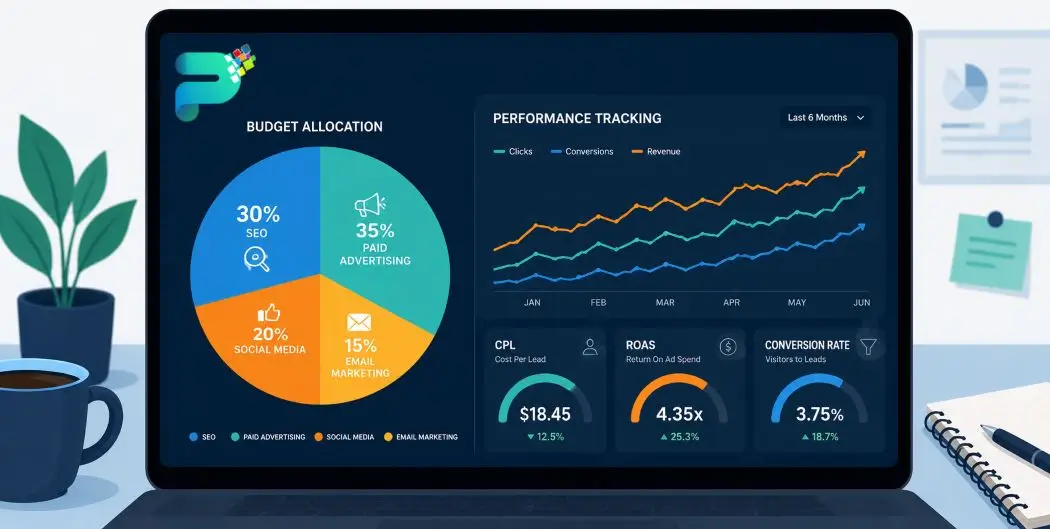
A strategy is only as useful as it is realistic — and that means having a clear sense of budget and how it will be distributed.
There’s no single “correct” marketing budget, but many businesses use a percentage-of-revenue approach as a starting point, often allocating a portion of revenue toward marketing depending on growth stage and industry norms. From there, the budget needs to be allocated across the channels identified in Step 4, based on priority and expected return.
A simplified example of how a budget might be broken down:
| Channel | Example Allocation |
|---|---|
| SEO & Content | 30% |
| Paid Advertising | 35% |
| Social Media | 20% |
| Email Marketing | 10% |
| Tools & Analytics | 5% |
These figures are starting points, not fixed rules — and one of the most important aspects of budget allocation is building in flexibility. Early-stage campaigns often involve testing, and being able to shift budget toward what’s working (and away from what isn’t) is a core part of a healthy strategy.
A digital marketing strategy blueprint isn’t a one-time document — it’s a living framework that should evolve based on real performance data.
This step loops back to the KPIs defined in Step 1. Regularly monitoring these metrics — whether that’s cost per lead, conversion rates, engagement, or ROAS — gives you a clear picture of what’s working and what isn’t.
Setting up a consistent review cycle is key. Many businesses find value in:
When the data shows a channel, campaign, or piece of content consistently underperforming against its KPI, that’s a signal to pivot — whether that means adjusting targeting, reallocating budget, or rethinking the approach entirely. Strategies that build in this kind of feedback loop tend to improve steadily over time, rather than repeating the same mistakes.
Building an effective digital marketing strategy doesn’t require complicated tools or massive budgets — it requires a clear, connected plan. By starting with well-defined goals, understanding your audience, choosing the right channels, planning content with intention, allocating budget thoughtfully, and consistently measuring results, you create a digital marketing strategy blueprint that actually drives sustainable growth rather than scattered activity.
If putting all of this together feels like a lot to manage on top of running your business, that’s exactly where the right support can make a difference. The team at Prodigmar specializes in helping businesses build and execute digital marketing strategies tailored to their specific goals and audience — turning a blueprint into real, measurable results. Reach out to Prodigmar today to start building a strategy that works for your business.
Even with a solid framework in mind, certain mistakes tend to come up again and again:
Avoiding these pitfalls often comes down to treating the blueprint as an ongoing process rather than a document to be created once and filed away.
A digital marketing strategy blueprint typically includes clearly defined business goals and KPIs, target audience research and buyer personas, a competitor and market analysis, channel selection, a content and campaign plan, budget allocation, and a system for tracking and measuring performance. Together, these elements form a connected framework rather than a list of isolated marketing activities.
The time it takes can vary widely depending on the size of the business, how much existing data and research is available, and the resources involved. For a small business with limited existing data, building out a basic strategy might take a few days to a couple of weeks. Larger businesses with more complex goals, multiple departments, or extensive market research may take several weeks to develop a comprehensive strategy.
A quarterly review is a common starting point for most businesses, allowing enough time to gather meaningful data while still being responsive to changes. That said, certain signals — such as a sudden drop in performance, a major shift in the market, or the launch of a new product — may warrant an earlier review outside the regular cycle.
Yes, the core framework of goals, audience research, channel selection, content planning, budget, and measurement applies regardless of business size. What typically changes is the scope and scale — small businesses may focus on fewer channels, work with smaller budgets, and rely on simpler tracking tools, while larger companies may apply the same framework across multiple teams, markets, or product lines.
The pixel runs in the browser and captures data client-side. The Events API runs on your server. Browser-side tracking gets blocked by ad blockers and iOS privacy settings. Server-side doesn't. Running both gives you the most complete picture. For most advertisers, start with the pixel. Add the Events API when you're ready to tighten accuracy.

Click to chat