
Instagram has evolved into one of the most powerful advertising platforms in digital marketing. Over two billion monthly users interact on Instagram, which gives businesses enormous opportunities to reach new audiences.
However, success does not come from simply launching ads.
It comes from precision targeting.
Many campaigns fail because advertisers push ads to broad audiences without strategy. Others spend heavily but attract the wrong users. The result? High costs, low conversions, and frustration.
This guide explains 12 High-Converting Instagram Ads Targeting Secrets that help businesses attract the right audience, increase engagement, and generate measurable growth.
Each strategy follows best practices recommended by platforms like Meta Platforms, which operates Instagram advertising through Meta Ads Manager.
Let’s break it down.
Instagram advertising operates on relevance.
If the platform detects that users interact with your ads, it reduces costs and improves delivery. If people ignore your ads, the platform raises costs or limits reach.
In simple terms:
Better targeting = Better results
Marketing research from HubSpot consistently shows that campaigns with refined audience segmentation generate significantly higher conversion rates than generic campaigns.
Targeting determines three critical metrics:
Get targeting right, and the algorithm works for you.
Get it wrong, and you burn budget quickly.
Many beginners choose extremely broad audiences.
They select a large geographic region and add only one interest.
This approach rarely works.
Instagram performs best when advertisers define clear audience signals.
For example:
Instead of targeting:
“Fitness”
Try targeting:
This method creates laser-focused audiences that match user behavior.
When ads appear relevant, engagement increases.
And when engagement increases, the algorithm rewards the campaign.
Poor targeting creates three common problems:
1. High ad costs
The algorithm struggles to identify interested users.
2. Low engagement
People scroll past irrelevant ads quickly.
3. Weak conversion rates
Traffic increases but sales remain stagnant.
According to advertising research shared by Hootsuite, audience segmentation often determines whether a campaign scales or fails.
In short, targeting strategy influences every stage of the ad funnel.
Now let’s explore the strategies that experienced advertisers use.
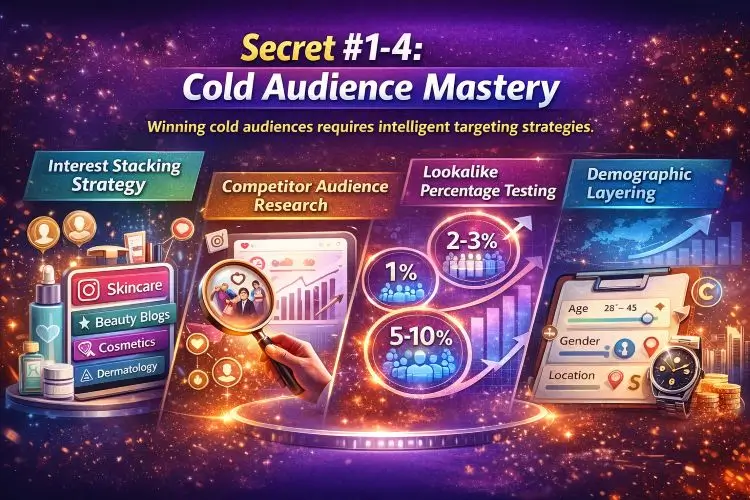
Cold audiences include people who have never interacted with your brand.
Winning them requires intelligent targeting strategies.
Interest stacking combines multiple related interests within one audience.
For example:
A brand selling skincare products might target:
Stacking interests increases audience relevance.
Instagram then identifies users who match multiple signals.
This improves ad delivery quality and reduces wasted impressions.
However, avoid stacking unrelated interests.
Relevance always wins.
Competitor targeting remains one of the most effective cold audience strategies.
Start by analyzing brands that already serve your ideal customers.
Look at:
Tools inside Meta Ads Manager allow advertisers to select interests related to competitor brands.
This tactic places your ads in front of users who already show interest in similar products.
It’s like advertising next to a competitor’s store — but digitally.
Lookalike audiences expand reach by finding users similar to existing customers.
Instagram analyzes behavioral patterns from your data.
Then it identifies new users who share those patterns.
Advertisers often test different percentages:
Lower percentages usually convert better.
Higher percentages help scale campaigns.
Testing multiple percentages helps discover the most profitable audience.
Demographic layering refines audiences by adding additional filters.
Common demographic signals include:
For example:
A luxury watch brand might target:
This layering dramatically increases audience relevance.
It also prevents budget waste on users unlikely to convert.
Not sure if your Instagram Ads targeting is costing you sales?
Follow Prodigmar for advanced targeting strategies that drive explosive growth.
Comment “TARGET” to get your FREE Audience Strategy Review today!
https://www.instagram.com/prodigmaroffical
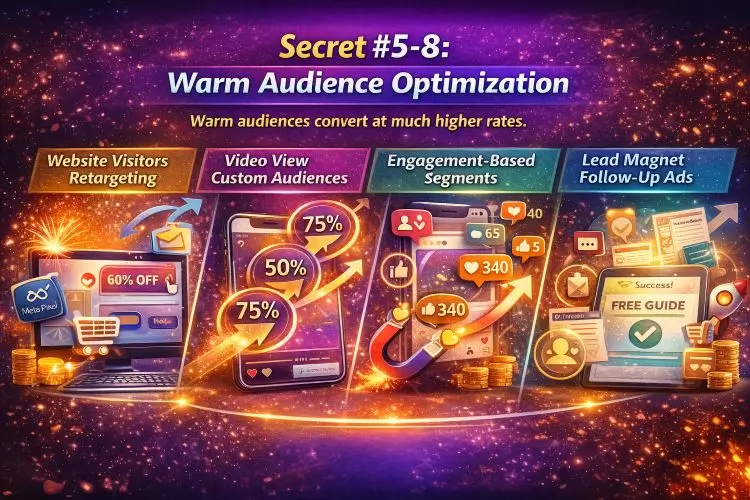
Warm audiences already interacted with your brand.
They visited your website, watched your videos, or engaged with your content.
These audiences often convert at much higher rates.
Website retargeting captures users who visited your site but did not purchase.
These users already showed intent.
They simply need a reminder.
Using tracking tools like the Meta Pixel, advertisers can retarget:
These campaigns often produce some of the highest ROI in digital advertising.
According to HubSpot, retargeted visitors are significantly more likely to convert than cold audiences.
Video content plays a major role on Instagram.
Advertisers can build audiences from users who watched their videos.
Common segments include:
People who watch longer portions show stronger interest.
Therefore, advertisers often target 75% viewers with direct sales ads.
This approach nurtures users through the funnel.
Instagram engagement audiences include users who:
These signals indicate real interest.
Instead of targeting everyone, advertisers focus on people already interacting with their brand.
Engagement retargeting feels natural because users already recognize the brand.
And familiarity increases trust.
Lead magnets attract prospects who show early-stage interest.
Examples include:
Once users download the resource, advertisers show follow-up ads promoting paid offers.
This technique moves prospects smoothly through the marketing funnel.
And it builds credibility before asking for a purchase.
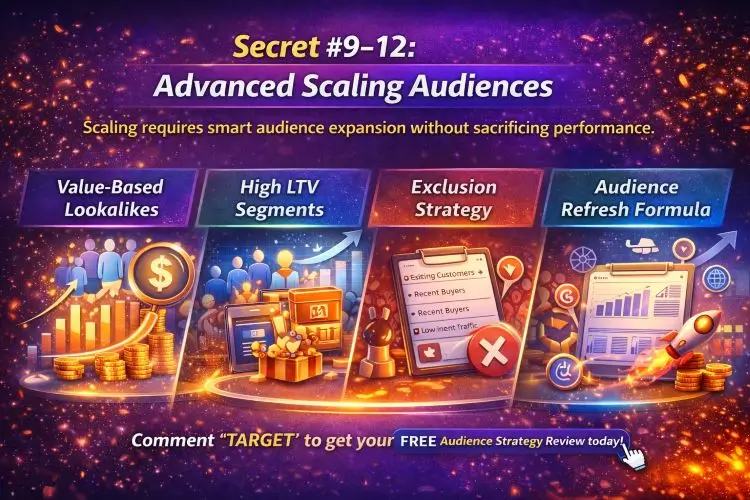
Once campaigns generate consistent results, advertisers shift toward scaling strategies.
Scaling requires smart audience expansion without sacrificing performance.
Standard lookalikes focus on behavioral similarities.
Value-based lookalikes add another layer.
They analyze customer purchase value.
The algorithm then prioritizes users who resemble high-spending customers, not just average ones.
This strategy helps attract premium buyers.
Brands selling higher-ticket products often rely on this technique.
LTV stands for Lifetime Value.
Some customers purchase repeatedly and spend more over time.
Identifying these users allows advertisers to build targeted segments.
For example:
Creating audiences from these users allows Instagram to find similar high-value customers.
That dramatically improves long-term profitability.
Smart advertisers know that targeting also means excluding the wrong users.
Common exclusions include:
Excluding these users prevents wasted budget.
For example:
If someone purchased yesterday, showing the same product ad again makes little sense.
Exclusion targeting keeps campaigns efficient.
Even strong audiences experience fatigue.
Users see the same ads repeatedly and stop responding.
Advertisers solve this problem by refreshing audiences regularly.
Common refresh methods include:
Refreshing audiences keeps campaigns dynamic and prevents performance decline.
Different business models require different targeting strategies.
Here is a simplified blueprint.
Focus on:
Prioritize:
Use:
Each model relies on the same foundation:
Precise audience targeting.
Instagram advertising does not fail because the platform lacks power.
Campaigns fail because advertisers target the wrong audiences.
The 12 High-Converting Instagram Ads Targeting Secrets explained above reveal how experienced marketers approach audience strategy.
They:
This systematic approach transforms Instagram from a simple ad platform into a predictable growth engine.
Businesses that master targeting gain a major competitive advantage.
Those that ignore it usually waste their advertising budgets.
Choose the first path.
Your campaigns will thank you.
Click to chat
No spam. No commitment. Just real insights.
We’ll contact you on WhatsApp about your audit. No commitment required.
No spam. No commitment. Just real insights.
We’ll contact you on WhatsApp about your audit. No commitment required.