Social Media Marketing Tips for Small Businesses: How to Grow Faster in 2026
Let’s be honest. Most small business owners post on social media, wait a few days, get three likes (one of them from their mum), and then wonder why nothing is happening.
The problem isn’t social media. It’s the lack of a clear strategy behind it.
In 2026, social media isn’t just a nice-to-have – it’s where your customers spend a significant chunk of their day. The average person now spends over two hours on social platforms daily. That’s two hours of potential attention, and your competitors are already fighting for it.
The good news? You don’t need a massive marketing budget or a full-time content team to make social media work. You need the right approach, the right platforms, and a few smart habits that compound over time.
This guide covers practical, no-fluff social media marketing tips for small businesses — from building your strategy to running paid ads and generating real leads. Whether you’re just getting started or looking to sharpen what you’re already doing, there’s something here for you.
Why Social Media Matters More Than Ever for Small Businesses
Here’s a number worth paying attention to: there are now over 5.4 billion social media users worldwide, representing roughly 66% of the global population. That’s not a niche channel – that’s the internet.
And yet, many small businesses treat social media like an afterthought – posting sporadically, copying what larger brands do, and measuring success by follower count rather than business outcomes.
The Real Cost of No Strategy
Posting without a plan is like driving without a destination. You’ll move, but you won’t arrive anywhere useful. Without a clear social media strategy, small businesses typically face three recurring problems:
- Inconsistent posting that kills algorithmic reach
- Generic content that doesn’t connect with their specific audience
- No way to measure what’s actually working
Meanwhile, organic reach continues to tighten on most platforms. Facebook’s average organic engagement sits between 0.07% and 0.15% for business pages. Instagram isn’t much more generous. The platforms want you to pay – but even paid advertising only works if the organic foundation is solid.
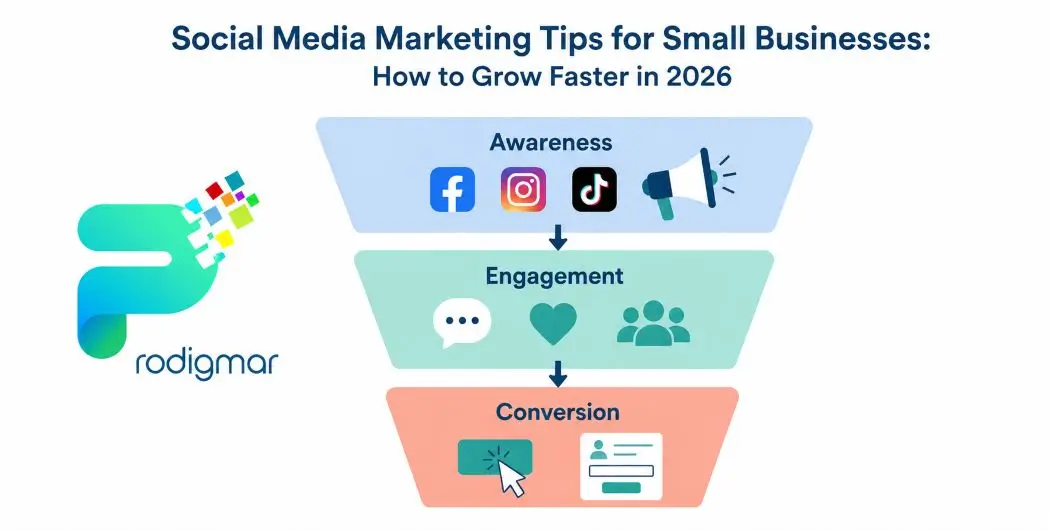
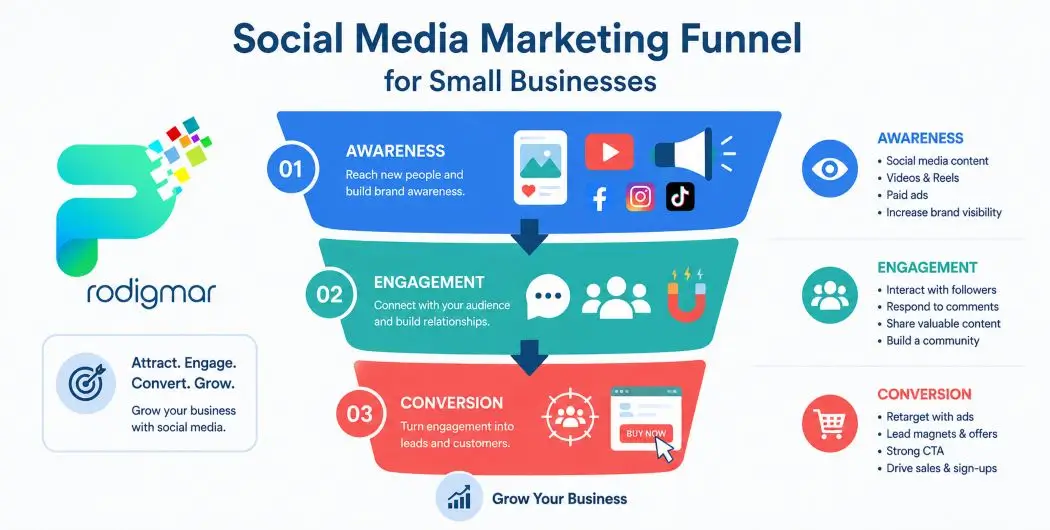
How Social Media Fits Into Your Marketing Funnel
Think of social media as a three-layer tool, not just a broadcasting channel:
- Top of funnel (Awareness): Short-form video, Reels, organic posts — getting your brand in front of new people
- Middle of funnel (Engagement): Community building, lead magnets, helpful content that builds trust
- Bottom of funnel (Conversion): Retargeting campaigns, direct offers, testimonials, calls to action
Most small businesses only think about the top layer. The businesses that grow consistently work all three.
Choosing the Right Platform for Your Business
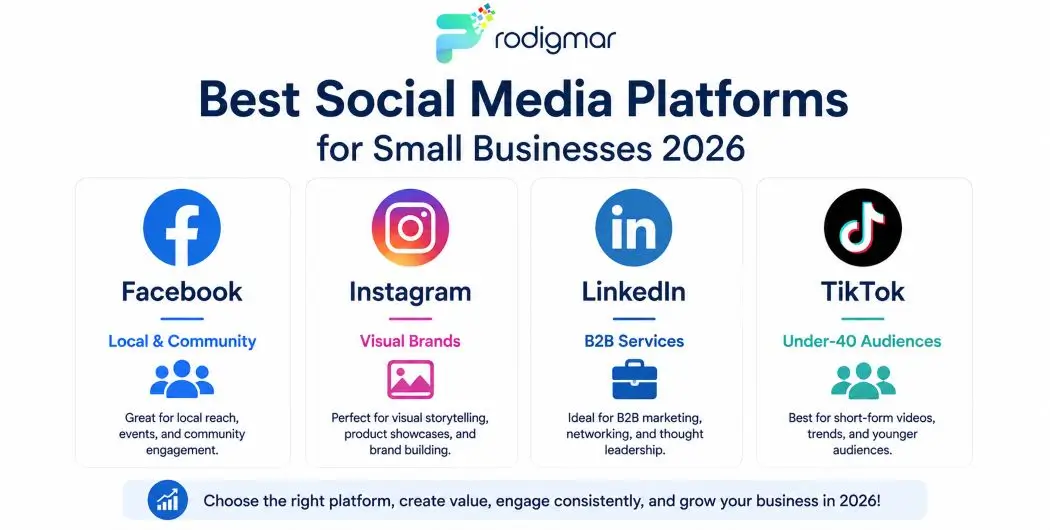
The biggest mistake small businesses make? Trying to be everywhere at once. You end up thin on every platform and strong on none. Pick two platforms that match your audience and go deep on those.
Here’s how the main platforms break down in 2026:
| Platform | Best For | Avg. Engagement Rate | Ad Costs | ROI Potential |
|---|---|---|---|---|
| Local businesses, 25–55 age group, community building | 0.07–0.15% organic; 5.07% overall | CPC ~$0.70–$1.92; CPL ~$8–$27 | High (esp. retargeting) | |
| Visual brands, products, lifestyle, food, fitness | 0.50–1.0% for business accounts | Similar to Facebook via Meta Ads | High for visual industries | |
| B2B services, professional consultants | 2–5% (multi-image: 6.6%) | CPM $35–$75 (premium) | Very high for B2B | |
| TikTok | Under-40 audiences, high organic reach | 3.70–5.69% (highest of all) | Low to moderate | High if content resonates |
| X (Twitter) | Real-time updates, news, thought leadership | 2.31% | Moderate | Moderate |
Facebook Marketing for Small Businesses
Facebook remains the most versatile platform for local businesses and those targeting adults aged 25 and above. With over three billion monthly active users, no other platform offers the same combination of reach, targeting precision, and affordable ad options.
What works particularly well for small businesses on Facebook:
- Facebook Groups for building a niche community around your brand
- Local awareness ads targeting specific suburbs or postcodes
- Video content – posts with visual content receive 10x more engagement than text-only posts
- Lead generation campaigns using Meta’s native Lead Ads format
Instagram Marketing Tips for Small Businesses
Instagram is a visual-first platform, which makes it a natural fit for product-based businesses, food and beverage brands, fitness, beauty, and home services. With over 2 billion monthly active users and 500 million people watching Stories every day, the audience is there.
What’s working on Instagram right now:
- Reels: Instagram Reels generate 22% more interactions than regular video posts (Hootsuite, 2025). Short, punchy, and relevant beats polished and generic every time.
- User-generated content (UGC): Reposting real customer photos builds credibility without any production budget. UGC receives 8.7x higher engagement than branded content.
- Stories polls and question stickers: Cheap engagement that also tells you exactly what your audience wants.
LinkedIn, TikTok & When to Branch Out
LinkedIn is non-negotiable for B2B service businesses. Four out of five LinkedIn members drive business decisions, and 89% of B2B marketers use it for lead generation. If your clients are businesses rather than consumers, LinkedIn deserves serious attention.
TikTok, meanwhile, now drives an average engagement rate of 3.70% – the highest of any major platform. And the “it’s just for teenagers” myth is fading fast as Gen Z grows into its spending years. If your audience skews younger or you have strong visual storytelling potential, TikTok is worth testing.
The rule of thumb: pick two platforms, master them, then expand. Consistency on two platforms beats mediocrity on five.
Building a Social Media Strategy That Actually Works
A strategy isn’t a content calendar. A strategy starts with a clear goal – and everything flows from there.
Setting SMART Goals for Your Social Media Campaigns
Before you post a single thing, answer this question: what do you actually want social media to do for your business?
The most common objectives for small businesses are:
- Brand awareness: Getting your name in front of more people in your target market
- Lead generation: Collecting enquiries, bookings, or sign-ups
- Customer retention: Keeping existing customers engaged and coming back
- Sales and conversions: Driving direct purchases or bookings
Each goal requires a different content approach and different metrics. Chasing follower count when your goal is leads is a common – and expensive – mistake.
Creating a Content Calendar That Keeps You Consistent
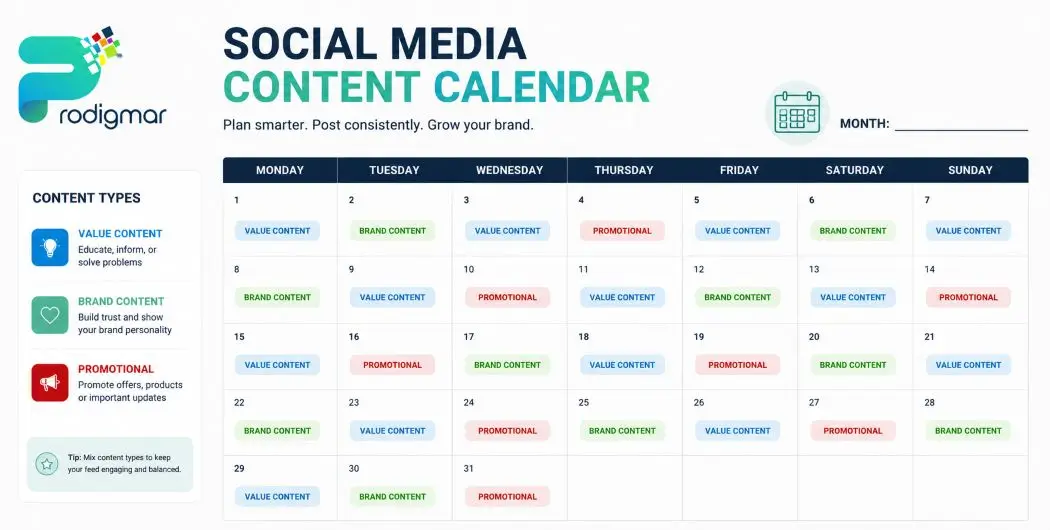
Here’s the thing about consistency: the algorithm rewards it more than you reward yourself. Showing up three times a week, every week, beats a burst of daily posts followed by a two-week silence every single time.
A simple content mix that works for most small businesses:
- 60% value: Tips, how-tos, answers to common questions, industry insights
- 20% brand: Behind-the-scenes, team moments, your story, social proof
- 20% promotional: Offers, services, calls to action
Tools to plan and schedule content without spending a lot: Meta Business Suite (free for Facebook and Instagram), Buffer, and Later all have solid free tiers for small businesses getting started.
Finding Your Brand Voice on Social Media
People don’t follow brands on social media. They follow personalities. Your brand voice should feel like a human being wrote it – not a corporate press release auto-generated on a Friday afternoon.
A few things that build authentic brand voice:
- Write the way you’d explain something to a friend – clear, direct, occasionally funny
- Share your opinion on industry topics, not just promotional updates
- Use social proof: customer reviews, testimonials, and real case results build trust far faster than any ad
In 2026, consumers on social media have ranked human-generated content as their top priority from brands – ahead of polished campaigns and influencer content. That’s a genuine green light to be real.
Struggling to Build a Social Media Strategy From Scratch?
You don't have to figure this out alone. Prodigmar builds data-driven social media strategies tailored to small businesses - from content planning to full campaign management.
Get a Free Social Media Audit →Social Media Marketing on a Budget - Affordable Tactics That Work
Good news: you don’t need to spend thousands to build a meaningful presence. Many of the most effective small business social media marketing ideas cost nothing beyond your time.
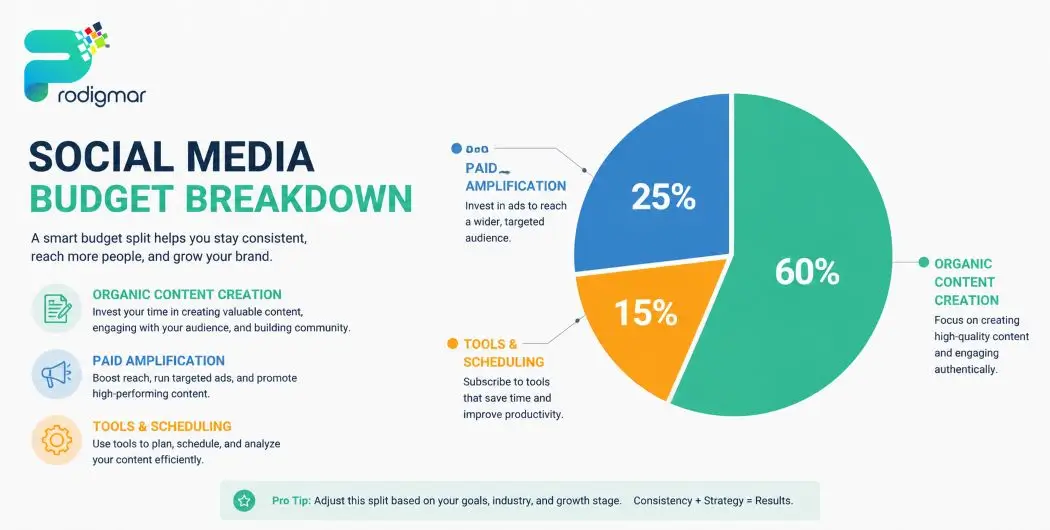
Organic vs. Paid Social – Finding the Right Balance
Organic content builds long-term brand equity. Paid advertising accelerates results. The smart approach is to run both – but in the right order.
For most small businesses starting out, the sequence looks like this:
- Build consistent organic content to establish your voice and test what resonates
- Identify your top-performing posts (reach, saves, comments)
- Amplify those specific posts with a small paid budget to reach new audiences
- Run dedicated lead generation campaigns once you understand your audience
The mistake most businesses make is jumping to paid advertising before understanding what their audience responds to. You end up paying to amplify content that doesn’t work.
Affordable Social Media Marketing Ideas for Small Businesses
These tactics consistently deliver results without requiring a big budget:
- Repurpose content across platforms. One blog post becomes a carousel on Instagram, a short video on TikTok, and three tweet-sized posts on X. One piece of content, four different posts.
- Lean on user-generated content. Ask happy customers to tag you in their posts. UGC receives 8.7x more engagement than branded content and costs you nothing to create.
- Micro-influencer partnerships. Local influencers with 5,000–50,000 followers often have stronger audience trust and far lower rates than major creators. Influencer marketing delivers an average ROI of $5.78 for every $1 spent.
- Offer a lead magnet. A free checklist, local guide, or discount code gives people a reason to engage and hand over their contact details.
- Engage before you broadcast. Spend 15 minutes each day commenting on posts from potential customers and local businesses in your space. Community building starts with showing up in other people’s conversations first.
Tracking What’s Working – Social Media Analytics Basics
You can’t improve what you don’t measure. Fortunately, all major platforms offer free native analytics, and you don’t need to be a data analyst to read them.
Key metrics every small business should track:
- Engagement rate: Are people actually responding to your content?
- Reach: How many unique accounts saw your post?
- Click-through rate: Are people taking the action you want?
- Cost per lead: Once you’re running ads, this is the number that tells you if your budget is working
Review your analytics monthly. Look for patterns – what type of content, what posting time, and what topic consistently performs above average – then do more of that.
Paid Social Advertising - Getting Results Without Wasting Budget
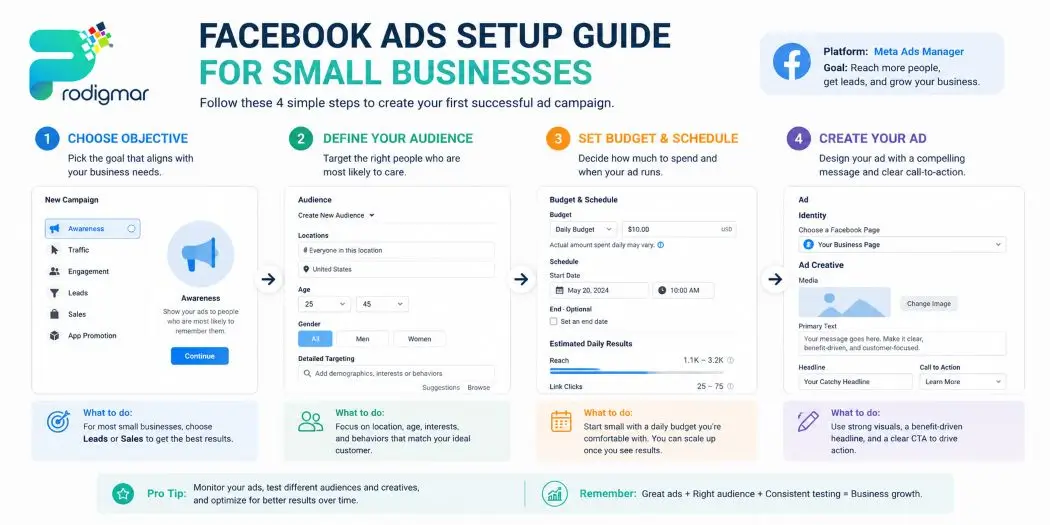
Let’s talk paid ads — specifically Meta Ads, which covers both Facebook and Instagram. This is where small businesses either unlock real growth or burn through cash with nothing to show for it. The difference usually comes down to preparation.
Facebook Ads and Meta Ads for Small Businesses – Where to Start
Meta Ads offer small businesses access to remarkably precise targeting for a relatively low entry cost. You can start with as little as $5–$10 per day and still get meaningful data to optimise from.
Here’s a realistic look at what Facebook advertising costs in 2025/2026:
- Cost per click (CPC): $0.70 for traffic campaigns; $1.92 for lead generation campaigns (WordStream, 2025)
- Cost per 1,000 impressions (CPM): Averages around $8–$16 depending on your audience and industry
- Cost per lead (CPL): Typically ranges from $8 to $27 across most industries; higher in competitive verticals like legal or finance
Your campaign objective matters enormously. Choose the wrong one and Facebook’s algorithm will optimise for the wrong thing. The six main objectives in Meta Ads Manager are: Awareness, Traffic, Engagement, Leads, App Promotion, and Sales. For most service-based small businesses, Leads is the right starting point.
Instagram Ads – Visual Formats That Convert
Instagram Ads run through the same Meta Ads Manager as Facebook. The key difference is format. On Instagram, the creative does more heavy lifting.
What works:
- Reels Ads: Short-form video that looks native — not like an ad — consistently outperforms static images
- Story Ads: Full-screen, vertical format with a clear call to action. Swipe-up friction is low.
- Carousel Ads: Great for showcasing multiple products, services, or before/after results
One practical rule: hook viewers in the first three seconds or you’ve lost them. That first frame is everything — make it visually strong or start with a question your audience instantly recognises.
Retargeting Campaigns – Your Highest-ROI Play
Retargeting is the practice of showing ads to people who have already interacted with your business — website visitors, video viewers, people who engaged with your page, or past customers.
It’s the highest-return activity in paid social advertising for one simple reason: these people already know who you are. The sale is warm, not cold.
A basic retargeting setup for a small business:
- Install the Meta Pixel on your website (free, takes 15 minutes)
- Build a custom audience of website visitors from the last 30–90 days
- Run a specific offer or testimonial ad to that audience with a direct CTA
- Exclude existing customers from the audience so you’re not paying to reach people who’ve already converted
| Factor | Facebook Ads | Instagram Ads |
|---|---|---|
| Best audience age | 25–55+ | 18–44 |
| Avg. CPM (2025) | ~$8–$16 | Similar (same Meta auction) |
| Best ad format | Video, carousel, lead form | Reels, Stories, carousel |
| Lead gen capability | Excellent (native Lead Ads) | Good (Story swipe-up, bio link) |
| Best for | Local services, community, offers | Visual products, lifestyle brands |
How to Generate Leads Through Social Media
Social media lead generation is one of the most misunderstood topics in small business marketing. A lot of business owners assume you need a complicated funnel or a big ad budget to collect leads from social platforms. You don’t.
The basics work remarkably well when executed consistently.
Lead Generation Strategies That Work on Social
Meta Lead Ads are the most direct route. These are ad formats where users submit their name, email, and phone number without ever leaving Facebook or Instagram. No landing page needed. Friction is low, which means more leads for less spend.
Other approaches that consistently deliver leads for small businesses:
- Link-in-bio funnels: One link (using a tool like Linktree or a dedicated landing page) that points to your key offers, lead magnets, or booking page
- Free consultations and quotes: A clear, low-commitment offer in your content and ads – “Book a free 20-minute call” converts well for service businesses
- Gated content: A downloadable checklist, guide, or template that requires an email address to access
- Social media contests: “Tag a friend and follow us to win” — low cost, high reach, builds your email list simultaneously
Marketing Automation for Social Media Leads
Collecting leads is step one. What happens next determines whether they convert or go cold.
A simple automation sequence for social media leads:
- Immediate response: An automated thank-you email or message within minutes of the enquiry. Research shows that contacting a lead within five minutes increases conversion rates by 7x.
- Follow-up sequence: Two or three emails over the next week sharing value — a case study, a helpful tip, a FAQ — before making any hard sales pitch
- Retargeting: If they don’t convert, serve them a retargeting ad on Facebook or Instagram to stay top of mind
Most email marketing tools — Mailchimp, ActiveCampaign, even HubSpot’s free tier – connect directly with Meta Lead Ads via Zapier. Setup takes an afternoon and then runs itself.
Measuring Your Social Media Lead Generation ROI
Three numbers tell you almost everything you need to know about whether your lead generation is working:
- Cost per lead (CPL): How much you’re paying to acquire one enquiry
- Lead-to-sale conversion rate: What percentage of those enquiries become paying customers
- Customer lifetime value (CLV): How much a customer is worth to your business over time
If your CPL is $20 and 10% of leads become customers who are each worth $500, your effective cost per acquisition is $200 – which is a strong return. The math tells you how hard you can afford to push your ad spend.
Ready to Turn Social Media Into a Lead Generation Machine?
Prodigmar works with small businesses to build targeted social media campaigns that convert — not just get likes. Let's talk about what's possible for yours.
Book a Free Strategy Call →Final Thoughts
Social media marketing for small businesses doesn’t have to be complicated or expensive. It does have to be intentional.
Start by choosing the right platform for your audience. Build a consistent content habit before spending money on ads. When you do go paid, start with a clear objective, set up your tracking, and let the data tell you what to scale.
The businesses that grow on social media in 2026 aren’t the ones posting the most. They’re the ones posting with purpose – showing up consistently, understanding their audience, and treating social media as a genuine part of their customer acquisition strategy rather than an occasional obligation.
If you’re looking for a digital marketing agency that specialises in helping small businesses build and execute this kind of strategy — or if you need someone to manage your PPC advertising alongside your organic social efforts – Prodigmar is here to help.
Pick one thing from this guide. Start today. The best time to build a social media presence for your business was six months ago. The second-best time is right now.
Frequently Asked Questions About Digital Marketing for Social Media
What is the best social media platform for small businesses?
How often should small businesses post on social media?
Can social media marketing generate leads for small businesses?
Is paid social media advertising worth it for small businesses?
How much should a small business spend on social media marketing?

Still have questions? Let's talk.
Every business is different. Book a free 1-on-1 consultation with a Prodigmar strategist and get a custom social media growth plan built around your goals, your budget, and your audience.